Medical Disclaimer: This is educational content only, not medical advice. Consult a licensed healthcare provider for diagnosis/treatment. Information based on sources like WHO/CDC guidelines (last reviewed: 2026-02-13).
This article is being expanded for more depth. Check back soon!
Body Fluid Compartments Explained with Clinical Case Scenarios and Fluid Shifts
Frequently Asked Questions
What are body fluid compartments?
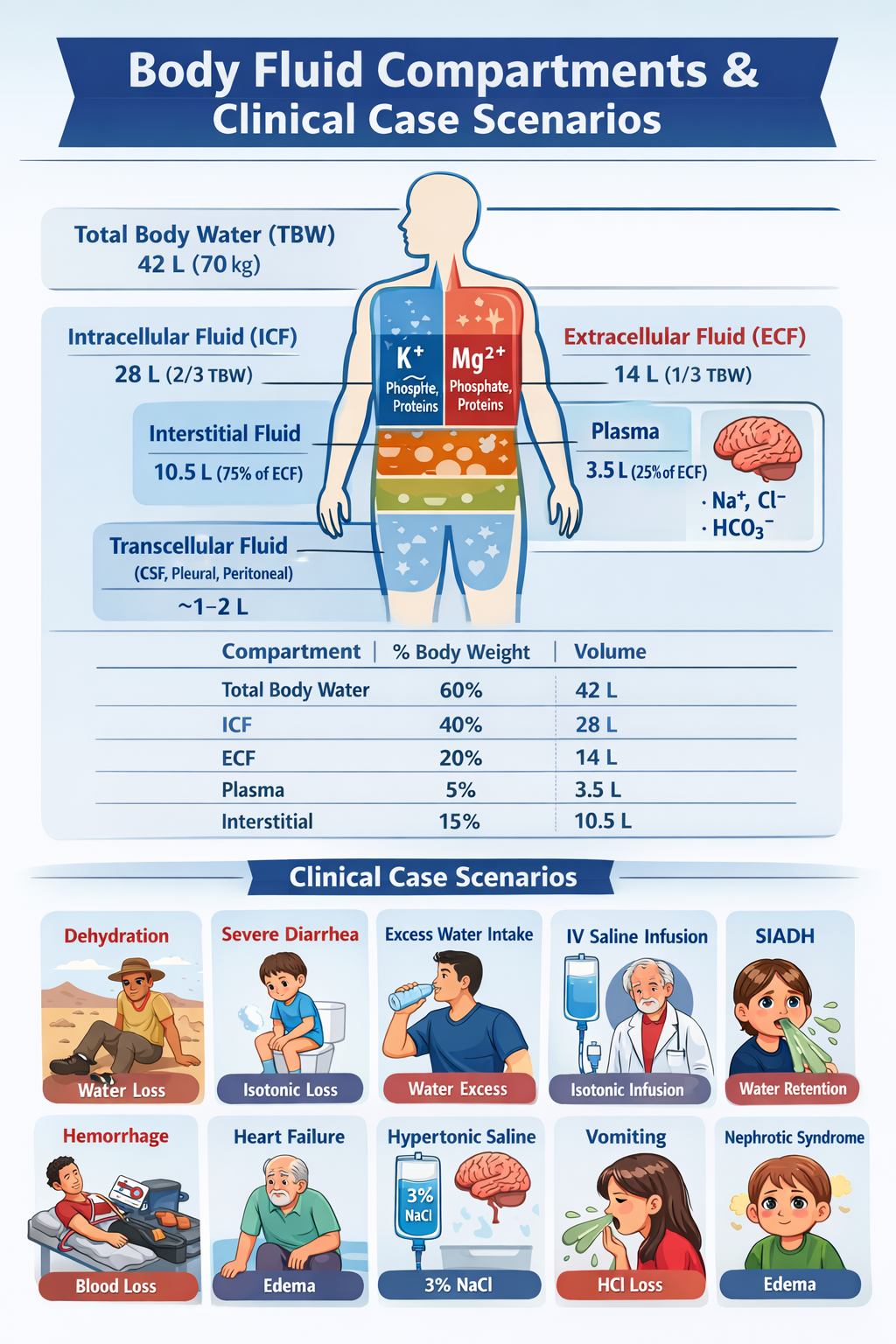
Body fluid compartments are the different spaces in the body where water is distributed, mainly divided into intracellular fluid (ICF) and extracellular fluid (ECF).
What is total body water (TBW)?
Total body water is the total amount of water in the human body, approximately 60% of body weight in adult males and 50% in adult females.
How is total body water distributed in the body?
TBW is distributed as two-thirds inside cells (ICF) and one-third outside cells (ECF).
What is intracellular fluid (ICF)?
Intracellular fluid is the fluid contained within body cells and makes up about 40% of body weight or 28 liters in a 70 kg adult male.
What is extracellular fluid (ECF)?
Extracellular fluid is the fluid outside body cells and makes up about 20% of body weight or 14 liters in a 70 kg adult male.
What are the main subdivisions of extracellular fluid?
ECF is subdivided into interstitial fluid (75% of ECF), plasma (25% of ECF), and a small transcellular fluid component.
What is interstitial fluid?
Interstitial fluid is the fluid present between tissue cells, accounting for about 10.5 liters in a 70 kg adult male.
What is plasma volume?
Plasma volume is the fluid component of blood inside vessels, accounting for about 3.5 liters in a 70 kg adult male.
What is transcellular fluid?
Transcellular fluid is a specialized part of ECF found in spaces such as cerebrospinal fluid, pleural fluid, peritoneal fluid, and synovial fluid.
Which ions are most abundant in intracellular fluid?
Potassium (K+), magnesium (Mg2+), phosphate, and proteins are the dominant intracellular ions.
Which ions are most abundant in extracellular fluid?
Sodium (Na+), chloride (Cl−), and bicarbonate (HCO3−) are the dominant extracellular ions.
What happens to fluid compartments during dehydration due to pure water loss?
ECF osmolarity increases, causing water to shift from ICF to ECF, leading to contraction of both compartments (hyperosmotic volume contraction).
What compartment change occurs in severe diarrhea?
Diarrhea causes isotonic fluid loss mainly from the ECF, producing isosmotic volume contraction with no major ICF change.
How does excessive water intake affect body fluid compartments?
Excess water decreases plasma osmolarity, causing water movement into cells, expanding both ICF and ECF (hyposmotic volume expansion).
What is the effect of normal saline infusion on compartments?
0.9% normal saline is isotonic, so it stays within the extracellular compartment and expands plasma and interstitial volumes.
What is the effect of hypertonic saline infusion?
Hypertonic saline increases ECF osmolarity, pulling water out of cells, expanding ECF and shrinking ICF.
What happens in SIADH regarding body fluid compartments?
SIADH causes excess water retention, leading to hyposmotic volume expansion with both ECF and ICF expansion.
Why does nephrotic syndrome cause edema?
Loss of albumin reduces plasma oncotic pressure, causing fluid shift from plasma into interstitial space, producing edema.
How does congestive heart failure lead to edema?
Heart failure increases venous and capillary hydrostatic pressure, pushing fluid into interstitial space and expanding ECF volume.
Why is rapid correction of hyponatremia dangerous?
Rapid correction can cause osmotic demyelination syndrome (central pontine myelinolysis), leading to severe neurological damage.
MCQ Test - Body Fluid Compartments Explained with Clinical Case Scenarios and Fluid Shifts
Progress:
0/15
Time: 00:00
Test Results
0%
0/15
0
Correct Answers
0
Wrong Answers
00:00
Time Taken
0
Skipped