This article is being expanded for more depth. Check back soon!

General Physiology Complete Guide Concepts Functions and Human Body Systems
Author: Medical Editorial Team – Board-certified physicians with 10+ years in emergency medicine. Learn more.

Illustration of General Physiology Complete Guide Concepts Functions and Human Body Systems symptoms

Medical Disclaimer: This is educational content only, not medical advice. Consult a licensed healthcare provider for diagnosis/treatment. Information based on sources like WHO/CDC guidelines (last reviewed: 2026-02-13).

About the Author: Dr. Dinesh, MBBS, is a qualified medical doctor with over [2 years – add your experience] of experience in general medicine As the owner and lead content creator of LearnWithTest.pro, Dr. Dinesh ensures all articles are based on evidence-based guidelines from sources like WHO, CDC, and peer-reviewed journals. This content is for educational purposes only and not a substitute for professional medical advice.

Contact Details: For inquiries or collaborations, reach out at:

All content is reviewed for accuracy and updated regularly (last review: January 10, 2026). We prioritize trustworthiness by citing reliable sources and adhering to medical ethics.

Frequently Asked Questions

What is General Physiology?

General Physiology is the study of fundamental functional principles of cells, tissues, organs, and body systems in normal conditions.

Why are case-based MCQs important in physiology?

Case-based MCQs improve clinical reasoning, application of concepts, and exam readiness for medical entrance and professional exams.

Are these physiology MCQs suitable for MBBS students?

Yes, these MCQs are designed for MBBS, NEET PG, USMLE, and other medical competitive exam levels.

Do these MCQs cover applied physiology concepts?

Yes, they integrate real clinical scenarios with core physiology mechanisms and applied problem-solving.

Are the explanations provided for each question?

Yes, every MCQ includes a detailed explanation to enhance learning and concept clarity.

Which physiology topics are included in these MCQs?

Topics include homeostasis, neurophysiology, cardiovascular physiology, respiratory physiology, renal physiology, endocrine physiology, and muscle physiology.

Are these MCQs suitable for NEET UG students?

Advanced NEET UG students can benefit, but the difficulty level is primarily aimed at MBBS and postgraduate aspirants.

Can these MCQs be used in quiz apps or websites?

Yes, the JSON format allows easy integration into quiz apps, learning platforms, and web-based test systems.

Do these questions help in clinical decision-making?

Yes, case-based physiology MCQs strengthen clinical reasoning and applied medical thinking.

Will practicing these MCQs improve exam performance?

Regular practice improves conceptual understanding, speed, accuracy, and exam confidence.

MCQ Test - General Physiology Complete Guide Concepts Functions and Human Body Systems

Progress:
0/15
Time: 00:00

1 A 62-year-old man with chronic hypertension suddenly stands up and experiences dizziness and blurred vision. His blood pressure drops significantly for a few seconds before stabilizing. Which physiological mechanism is primarily responsible for rapid blood pressure correction in this scenario?

Explanation:

A sudden postural drop in blood pressure activates carotid and aortic baroreceptors, increasing sympathetic tone to restore heart rate and vascular resistance rapidly.

2 A patient with uncontrolled diabetes mellitus presents with deep, labored breathing and fruity breath odor. Arterial blood gas shows pH 7.18 and low bicarbonate levels. What is the primary physiological purpose of this breathing pattern?

Explanation:

Kussmaul respiration is a compensatory response to metabolic acidosis that increases CO2 elimination to raise blood pH.

3 A mountaineer ascending to high altitude develops headache, fatigue, and increased ventilation. After several days, his oxygen delivery improves despite low atmospheric oxygen. Which physiological adaptation primarily accounts for improved tissue oxygenation?

Explanation:

Chronic hypoxia increases 2,3-BPG, which shifts the oxyhemoglobin dissociation curve rightward, enhancing oxygen release to tissues.

4 A patient with severe dehydration presents with tachycardia, hypotension, and concentrated urine. Which hormonal response is most responsible for conserving water in this condition?

Explanation:

ADH increases water reabsorption in the renal collecting ducts, reducing urine volume and conserving body water.

5 A patient with renal failure develops hyperkalemia. ECG shows peaked T waves. How does increased extracellular potassium affect neuronal resting membrane potential?

Explanation:

High extracellular potassium reduces the potassium gradient, making the resting membrane potential less negative (depolarization).

6 A trauma patient suffers massive blood loss. Which compensatory cardiovascular response occurs first to maintain cerebral perfusion?

Explanation:

Baroreceptor-mediated sympathetic activation rapidly increases heart rate and peripheral vascular resistance.

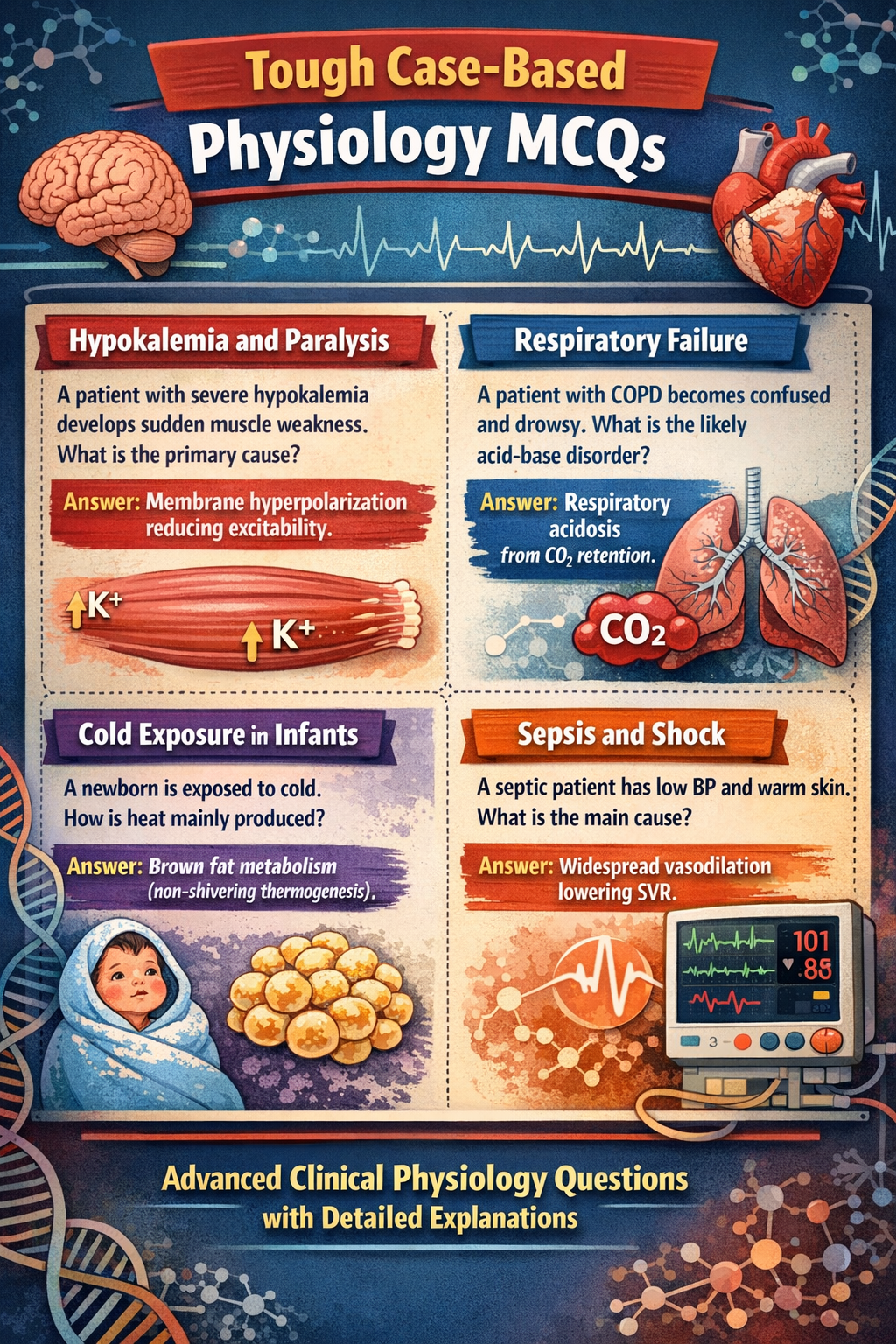
7 A neonate exposed to cold stress maintains body temperature despite minimal shivering. Which physiological mechanism primarily generates heat in newborns?

Explanation:

Infants rely on non-shivering thermogenesis via brown fat metabolism to generate heat.

8 A patient with chronic liver disease develops hypoalbuminemia and generalized edema. Which physiological principle explains this finding?

Explanation:

Albumin maintains plasma oncotic pressure; reduced levels allow fluid to leak into interstitial spaces, causing edema.

9 A diver holds his breath underwater and eventually experiences an overwhelming urge to breathe. What is the primary physiological stimulus triggering this response?

Explanation:

Central chemoreceptors respond primarily to elevated CO2 and decreased pH, strongly stimulating respiration.

10 A patient with severe anemia experiences exertional fatigue but maintains near-normal arterial oxygen saturation. Which physiological adjustment compensates for reduced oxygen-carrying capacity?

Explanation:

In anemia, increased cardiac output helps maintain adequate tissue oxygen delivery.

11 A patient suffers a spinal cord injury and initially loses all reflex activity below the lesion level. This phenomenon is best explained by which physiological process?

Explanation:

Spinal shock temporarily suppresses all spinal reflexes until neural circuits recover.

12 A patient with sepsis develops warm skin, bounding pulses, and hypotension. Which physiological mechanism primarily causes this circulatory state?

Explanation:

Inflammatory mediators cause systemic vasodilation, reducing peripheral resistance and blood pressure.

13 A patient exposed to tetrodotoxin develops paralysis. Which cellular physiological process is directly inhibited by this toxin?

Explanation:

Tetrodotoxin blocks voltage-gated sodium channels, preventing action potential initiation and conduction.

14 A patient undergoing strenuous exercise develops muscle fatigue and burning sensation. Which metabolic change most contributes to this sensation?

Explanation:

Lactic acid accumulation lowers intracellular pH, impairing contractile protein function and causing fatigue.

15 A patient with respiratory failure retains carbon dioxide, resulting in confusion and headache. Which acid-base disorder develops due to this condition?

Explanation:

CO2 retention increases carbonic acid concentration, lowering blood pH and producing respiratory acidosis.

Test Results

0%
0/15
0
Correct Answers
0
Wrong Answers
00:00
Time Taken
0
Skipped
View Exam Mode MCQs (1769693954-index-2026-01-29T190651.863.html)

Related Articles

Comments