First Heart Sound S1 and Jugular Venous Pressure JVP Complete Clinical Guide
Author: Medical Editorial Team – Board-certified physicians with 10+ years in emergency medicine. Learn more.

Illustration of First Heart Sound S1 and Jugular Venous Pressure JVP Complete Clinical Guide symptoms

Medical Disclaimer: This is educational content only, not medical advice. Consult a licensed healthcare provider for diagnosis/treatment. Information based on sources like WHO/CDC guidelines (last reviewed: 2026-02-13).

About the Author: Dr. Dinesh, MBBS, is a qualified medical doctor with over [2 years – add your experience] of experience in general medicine As the owner and lead content creator of LearnWithTest.pro, Dr. Dinesh ensures all articles are based on evidence-based guidelines from sources like WHO, CDC, and peer-reviewed journals. This content is for educational purposes only and not a substitute for professional medical advice.

Contact Details: For inquiries or collaborations, reach out at:

All content is reviewed for accuracy and updated regularly (last review: January 10, 2026). We prioritize trustworthiness by citing reliable sources and adhering to medical ethics.

Frequently Asked Questions

What is the first heart sound S1?

The first heart sound S1 is produced mainly by closure of the mitral and tricuspid valves at the onset of ventricular systole and coincides with the carotid pulse and R wave of ECG.

What are the components of S1?

S1 consists of two components: M1 from mitral valve closure and T1 from tricuspid valve closure, which are usually heard as a single sound.

What causes a loud S1?

A loud S1 occurs when AV valve leaflets are wide open at the start of systole, commonly seen in mitral stenosis with mobile leaflets, short PR interval, tachycardia, and hyperdynamic states.

What causes a soft S1?

A soft S1 is seen in mitral regurgitation, long PR interval, left ventricular dysfunction, and calcified or immobile mitral valves.

Why does S1 vary in intensity in atrial fibrillation?

In atrial fibrillation, variable diastolic filling leads to inconsistent ventricular contraction force, resulting in beat-to-beat variation in S1 intensity.

What is jugular venous pressure JVP?

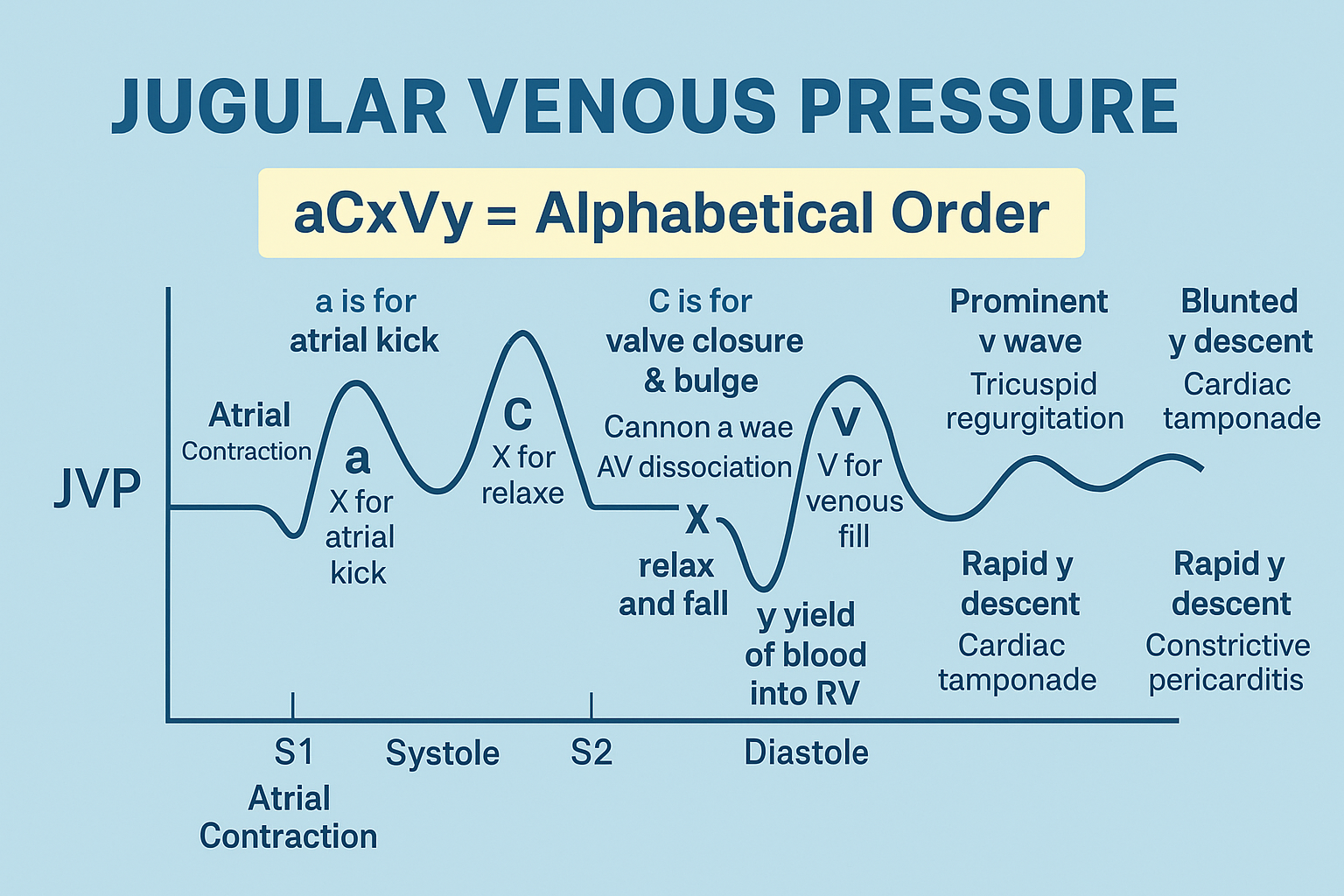
Jugular venous pressure is a clinical estimate of right atrial pressure assessed by observing pulsations of the internal jugular vein.

Why is the internal jugular vein used to assess JVP?

The internal jugular vein has a direct connection to the right atrium without valves, making it a reliable indicator of right atrial pressure.

What are the normal components of the JVP waveform?

The normal JVP waveform includes the a wave, c wave, x descent, v wave, and y descent, reflecting different phases of the cardiac cycle.

What causes absent a waves in JVP?

Absent a waves are seen in atrial fibrillation due to loss of organized atrial contraction.

What are cannon a waves and when are they seen?

Cannon a waves are large intermittent a waves caused by atrial contraction against a closed tricuspid valve, seen in complete heart block and other forms of AV dissociation.

What is Kussmaul sign?

Kussmaul sign is a paradoxical rise in JVP during inspiration, seen in constrictive pericarditis, restrictive cardiomyopathy, and right ventricular infarction.

What is the clinical significance of raised JVP?

Raised JVP indicates elevated right atrial pressure and is commonly seen in right heart failure, tricuspid valve disease, pericardial disease, and fluid overload.

MCQ Test - First Heart Sound S1 and Jugular Venous Pressure JVP Complete Clinical Guide

Progress:
0/15
Time: 00:00

1 A 28-year-old woman with exertional dyspnea has a loud, tapping first heart sound best heard at the apex. ECG shows normal PR interval. Which pathological feature best explains this auscultatory finding?

Explanation:

A loud, tapping S1 is characteristic of mitral stenosis with mobile leaflets that close forcefully at the onset of systole.

2 A patient with chronic mitral regurgitation has a soft first heart sound. What is the primary mechanism?

Explanation:

In mitral regurgitation, the mitral valve does not close effectively at the onset of systole, resulting in a soft S1.

3 A 64-year-old man with atrial fibrillation shows beat-to-beat variation in S1 intensity. What causes this phenomenon?

Explanation:

Irregular diastolic filling in atrial fibrillation leads to variable AV valve position and changing S1 intensity.

4 A wide split S1 is heard at the lower left sternal border in a patient. Which condition most likely explains this finding?

Explanation:

Right bundle branch block delays right ventricular contraction, causing delayed tricuspid valve closure and wide S1 splitting.

5 A patient with pulmonary hypertension has raised JVP and prominent a waves. What is the underlying mechanism?

Explanation:

Pulmonary hypertension leads to forceful right atrial contraction against a noncompliant right ventricle, producing giant a waves.

6 Intermittent giant a waves are observed in the neck veins of a patient with complete heart block. These waves are termed?

Explanation:

Cannon a waves occur when atrial contraction coincides with closed tricuspid valve due to AV dissociation.

7 A hypotensive patient has elevated JVP with absent y descent. Which diagnosis is most likely?

Explanation:

Cardiac tamponade restricts ventricular filling, leading to absent or blunted y descent in JVP.

8 A patient with constrictive pericarditis shows which characteristic JVP feature?

Explanation:

Constrictive pericarditis causes rapid early diastolic filling followed by abrupt cessation, producing a steep y descent.

9 A patient with severe tricuspid regurgitation presents with systolic pulsations in the neck veins. Which JVP component is exaggerated?

Explanation:

Tricuspid regurgitation causes systolic backflow into the right atrium, leading to prominent v waves.

10 JVP rises paradoxically during inspiration in a patient. Which condition is most consistent with this finding?

Explanation:

Kussmaul sign, a paradoxical inspiratory rise in JVP, is classically seen in constrictive pericarditis.

11 Absent a waves are noted on JVP examination. Which rhythm abnormality is most likely?

Explanation:

Atrial fibrillation abolishes coordinated atrial contraction, resulting in absent a waves.

12 A patient with first-degree AV block has a soft S1. What best explains this finding?

Explanation:

A prolonged PR interval allows AV valves to drift toward closure before systole, reducing S1 intensity.

13 A loud S1 with an opening snap is heard in a patient. Which diagnosis is most likely?

Explanation:

Loud S1 with opening snap is characteristic of mitral stenosis with pliable valve leaflets.

14 Sustained elevation of JVP during abdominal compression indicates reduced reserve of which cardiac chamber?

Explanation:

Positive hepatojugular reflux reflects limited right ventricular functional reserve.

15 A patient with dilated cardiomyopathy has a soft first heart sound. What is the primary reason?

Explanation:

Dilated cardiomyopathy reduces ventricular contractility, resulting in diminished S1 intensity.

Test Results

0%
0/15
0
Correct Answers
0
Wrong Answers
00:00
Time Taken
0
Skipped
View Exam Mode MCQs (1767077007-index-2025-12-30T121024.591.html)

Related Articles

Comments