Medical Disclaimer: This is educational content only, not medical advice. Consult a licensed healthcare provider for diagnosis/treatment. Information based on sources like WHO/CDC guidelines (last reviewed: 2026-02-13).
This article is being expanded for more depth. Check back soon!
Disorders of Development in Pediatrics: Developmental Delay, Autism, GDD Diagnosis and Management
Frequently Asked Questions
What are disorders of development in pediatrics?
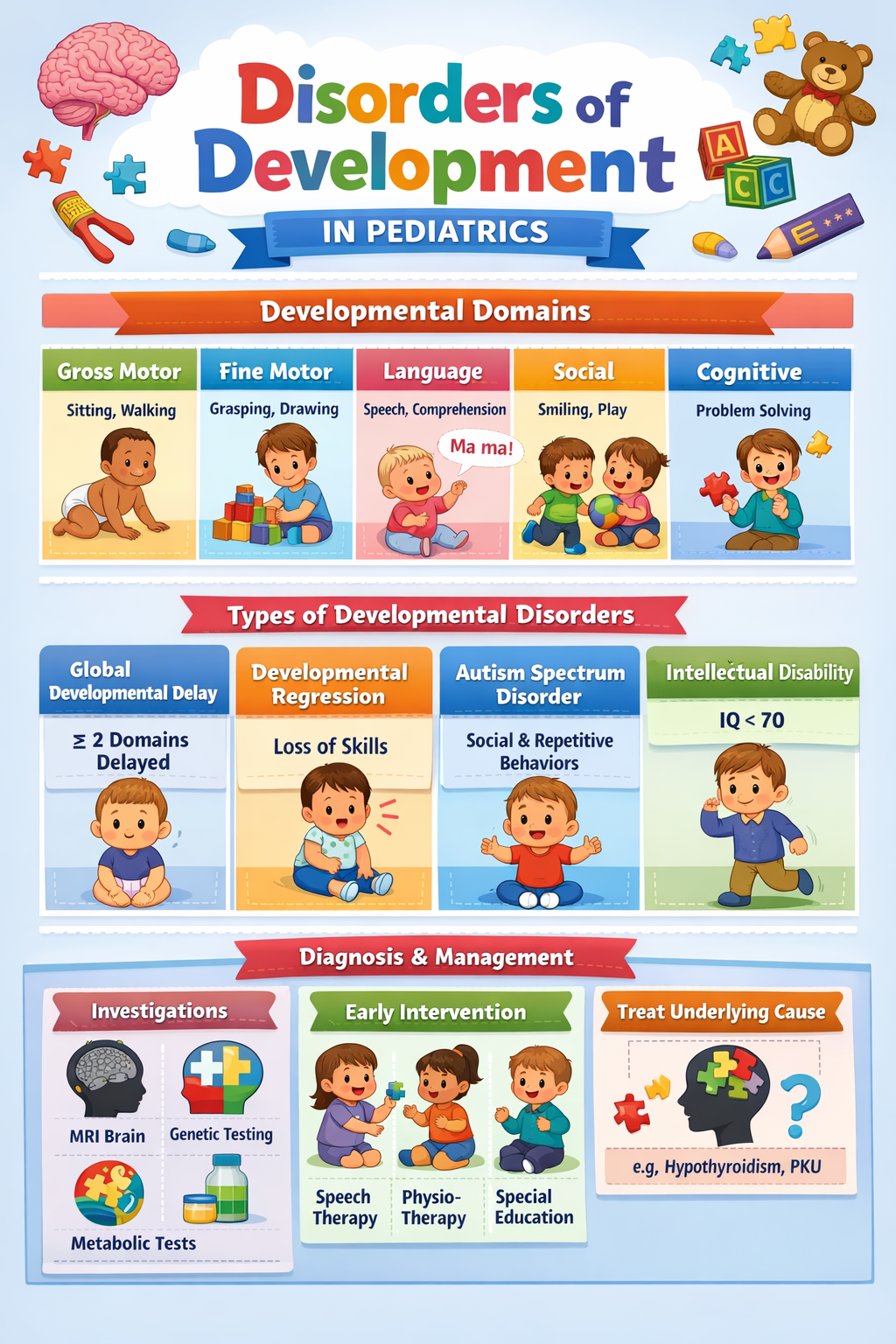
Disorders of development are conditions in which a child fails to achieve expected developmental milestones in one or more domains such as gross motor, fine motor, language, social, or cognitive development.
What is the difference between developmental delay and developmental regression?
Developmental delay means a child is slower than expected in achieving milestones, whereas developmental regression refers to loss of previously acquired skills and is always abnormal.
What is global developmental delay (GDD)?
Global developmental delay is defined as significant delay in two or more developmental domains (motor, language, cognitive, social, or adaptive skills) in children under 5 years.
What are common causes of developmental delay?
Common causes include genetic syndromes (Down syndrome, Fragile X), congenital infections (TORCH), birth asphyxia, prematurity, metabolic disorders, CNS infections, malnutrition, and environmental deprivation.
What are red flag signs of developmental delay?
Red flags include no social smile by 3 months, not sitting by 9 months, not walking by 18 months, no single words by 16 months, no two-word phrases by 2 years, and any developmental regression.
How is developmental delay evaluated clinically?
Evaluation includes detailed prenatal, perinatal, and developmental history, milestone assessment, physical and neurological examination, screening tools, and targeted investigations.
Which screening tools are used for developmental disorders?
Common tools include Denver Developmental Screening Test (DDST), Ages and Stages Questionnaire (ASQ), and M-CHAT for autism screening.
When is MRI brain indicated in a child with developmental delay?
MRI is indicated when there is developmental regression, seizures, abnormal head size, focal neurological signs, or suspicion of structural brain abnormalities.
What is the most common cause of isolated speech delay?
Hearing impairment is one of the most common and reversible causes of isolated speech delay, so hearing assessment is essential.
How does autism spectrum disorder differ from intellectual disability?
Autism is characterized by impaired social communication and repetitive behaviors, while intellectual disability involves global cognitive impairment with deficits in adaptive functioning.
What investigations are essential in global developmental delay?
Key investigations include hearing and vision testing, thyroid function tests, genetic testing (chromosomal microarray, Fragile X), and metabolic screening when regression is present.
What is the role of early intervention in developmental disorders?
Early intervention with physiotherapy, occupational therapy, speech therapy, and special education significantly improves developmental outcomes and quality of life.
Can developmental delay be reversible?
Some causes are reversible, such as congenital hypothyroidism or hearing impairment, if treated early, while genetic and neurodegenerative causes are usually not reversible.
What is the management approach for autism spectrum disorder?
Management includes behavioral therapies such as Applied Behavior Analysis (ABA), structured educational support, speech therapy, and medications like risperidone for severe aggression if needed.
What are the key principles in managing developmental disorders?
Key principles include early identification, multidisciplinary intervention, treatment of underlying causes, family counseling, and long-term developmental support.
MCQ Test - Disorders of Development in Pediatrics: Developmental Delay, Autism, GDD Diagnosis and Management
Progress:
0/15
Time: 00:00
Test Results
0%
0/15
0
Correct Answers
0
Wrong Answers
00:00
Time Taken
0
Skipped