This article is being expanded for more depth. Check back soon!

Addison’s Disease Comprehensive Clinical Guide Diagnosis Causes and Management
Author: Medical Editorial Team – Board-certified physicians with 10+ years in emergency medicine. Learn more.

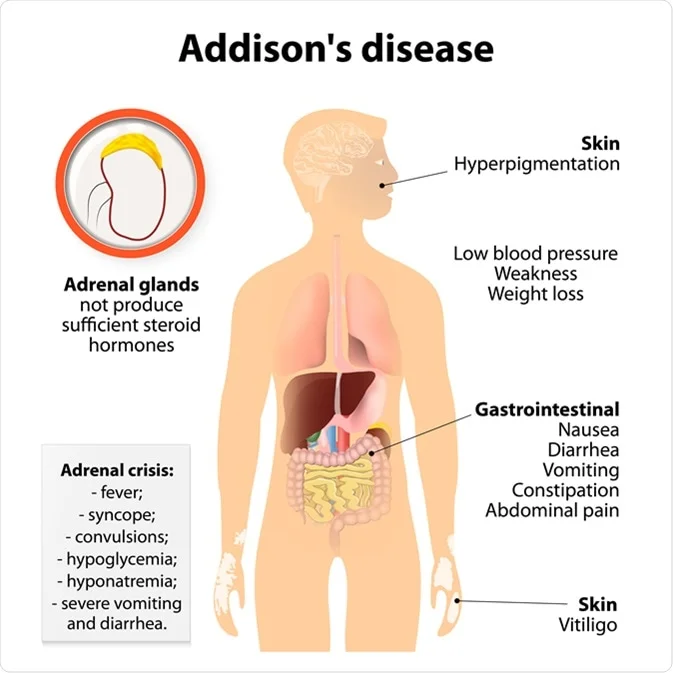
Illustration of Addison’s Disease Comprehensive Clinical Guide Diagnosis Causes and Management symptoms

Medical Disclaimer: This is educational content only, not medical advice. Consult a licensed healthcare provider for diagnosis/treatment. Information based on sources like WHO/CDC guidelines (last reviewed: 2026-02-13).

About the Author: Dr. Dinesh, MBBS, is a qualified medical doctor with over [2 years – add your experience] of experience in general medicine As the owner and lead content creator of LearnWithTest.pro, Dr. Dinesh ensures all articles are based on evidence-based guidelines from sources like WHO, CDC, and peer-reviewed journals. This content is for educational purposes only and not a substitute for professional medical advice.

Contact Details: For inquiries or collaborations, reach out at:

All content is reviewed for accuracy and updated regularly (last review: January 10, 2026). We prioritize trustworthiness by citing reliable sources and adhering to medical ethics.

Frequently Asked Questions

What is Addison’s disease?

Addison’s disease is primary adrenal insufficiency caused by destruction or dysfunction of the adrenal cortex, resulting in deficiency of cortisol, aldosterone, and adrenal androgens.

How is Addison’s disease different from secondary adrenal insufficiency?

Addison’s disease involves adrenal gland failure with high ACTH and hyperkalemia, while secondary adrenal insufficiency is due to pituitary or hypothalamic causes with normal aldosterone and no hyperkalemia.

What is the most common cause of Addison’s disease?

Autoimmune adrenalitis is the most common cause in developed countries, while tuberculosis is the most common cause worldwide.

Why does hyperpigmentation occur in Addison’s disease?

Loss of cortisol feedback causes elevated ACTH, which increases melanocyte-stimulating hormone activity, leading to hyperpigmentation.

What are the hallmark electrolyte abnormalities in Addison’s disease?

Hyponatremia and hyperkalemia due to aldosterone deficiency are hallmark findings.

What is the gold standard diagnostic test for Addison’s disease?

The ACTH (cosyntropin) stimulation test is the gold standard for diagnosis.

What is Addisonian crisis?

Addisonian crisis is a life-threatening emergency characterized by hypotension, shock, hypoglycemia, vomiting, and electrolyte imbalance.

What is the immediate treatment for Addisonian crisis?

Immediate IV hydrocortisone, aggressive IV normal saline with dextrose, correction of electrolytes, and treatment of the precipitating cause.

What medications are used for long-term treatment of Addison’s disease?

Lifelong glucocorticoid replacement with hydrocortisone and mineralocorticoid replacement with fludrocortisone.

Why is stress-dose steroid therapy important?

During illness, surgery, or trauma, steroid requirements increase; failure to increase doses can precipitate adrenal crisis.

Can Addison’s disease be cured?

Addison’s disease cannot be cured, but it can be effectively managed with lifelong hormone replacement therapy.

Which autoimmune conditions are commonly associated with Addison’s disease?

Type 1 diabetes, autoimmune thyroid disease, pernicious anemia, and vitiligo as part of autoimmune polyglandular syndrome type 2.

Why do women with Addison’s disease lose axillary and pubic hair?

Due to deficiency of adrenal androgens, which contribute to secondary sexual hair in women.

What patient education is essential in Addison’s disease?

Never stopping steroids abruptly, carrying a medical alert ID, using stress dosing during illness, and having emergency injectable hydrocortisone.

What is the prognosis of Addison’s disease?

With proper treatment, compliance, and patient education, the prognosis is excellent.

MCQ Test - Addison’s Disease Comprehensive Clinical Guide Diagnosis Causes and Management

Progress:
0/15
Time: 00:00

1 A 34-year-old woman presents with fatigue, weight loss, salt craving, and darkening of skin over knuckles and oral mucosa. Blood pressure is 90/60 mmHg. Labs show Na+ 124 mmol/L and K+ 5.9 mmol/L. What is the most likely diagnosis?

Explanation:

Hyperpigmentation, hypotension, hyponatremia, and hyperkalemia are classic for primary adrenal insufficiency (Addison’s disease).

2 A patient with suspected Addison’s disease undergoes ACTH (cosyntropin) stimulation test. Cortisol fails to rise adequately. What does this confirm?

Explanation:

Failure of cortisol to rise after ACTH confirms primary adrenal insufficiency.

3 Which electrolyte abnormality best differentiates Addison’s disease from secondary adrenal insufficiency?

Explanation:

Hyperkalemia occurs only in primary adrenal insufficiency due to aldosterone deficiency.

4 A patient with Addison’s disease has very high ACTH levels. What clinical sign results from this elevation?

Explanation:

Elevated ACTH increases melanocyte-stimulating hormone activity, causing hyperpigmentation.

5 The most common cause of Addison’s disease worldwide is?

Explanation:

Tuberculosis remains the most common cause of Addison’s disease worldwide.

6 A patient with Addison’s disease presents with vomiting, hypotension, hypoglycemia, and altered sensorium.

Explanation:

These features indicate Addisonian crisis, a life-threatening emergency.

7 First-line treatment of Addisonian crisis includes?

Explanation:

Immediate IV hydrocortisone and isotonic saline are lifesaving in adrenal crisis.

8 Which hormone deficiency is responsible for salt craving in Addison’s disease?

Explanation:

Aldosterone deficiency causes sodium loss, leading to salt craving.

9 A patient with Addison’s disease is started on chronic replacement therapy. Which combination is correct?

Explanation:

Both glucocorticoid and mineralocorticoid replacement are required.

10 Which instruction is most important to counsel a patient with Addison’s disease?

Explanation:

Stress dosing during illness prevents adrenal crisis.

11 A patient with Addison’s disease also has autoimmune thyroid disease and type 1 diabetes.

Explanation:

APS type 2 includes Addison’s disease, autoimmune thyroid disease, and type 1 diabetes.

12 Which lab finding supports Addison’s disease over SIADH?

Explanation:

Hyperkalemia occurs due to aldosterone deficiency in Addison’s disease.

13 A patient on long-term steroid therapy abruptly stops medication and develops adrenal insufficiency.

Explanation:

Abrupt steroid withdrawal causes secondary adrenal insufficiency, not Addison’s disease.

14 Loss of axillary and pubic hair in women with Addison’s disease is due to deficiency of?

Explanation:

Adrenal androgen deficiency causes loss of body hair in women.

15 With proper treatment and compliance, the prognosis of Addison’s disease is?

Explanation:

With lifelong hormone replacement and education, prognosis is excellent.

Test Results

0%
0/15
0
Correct Answers
0
Wrong Answers
00:00
Time Taken
0
Skipped
View Exam Mode MCQs (1768894835-index-2026-01-20T130959.615.html)

Related Articles

Comments