✅ NORMAL NEWBORN & IUGR (INTRAUTERINE GROWTH RESTRICTION) – FULL DETAIL
1. NORMAL NEWBORN (TERM BABY)
Definition
A normal term newborn is a baby born:
- Between 37–42 weeks gestation
- With appropriate weight for gestational age (AGA)
- Without major illness or congenital anomaly
Normal Measurements (Term Baby)
| Parameter | Normal Range |
| ------------------- | ---------------- |
| Birth weight | 2.5 – 4.0 kg |
| Length | 45 – 55 cm |
| Head circumference | 33 – 35 cm |
| Chest circumference | 30 – 33 cm |
Normal Vital Signs in Newborn
| Vital Sign | Normal Value |
| ----------------- | ---------------------- |
| Temperature | 36.5 – 37.5°C |
| Heart rate | 120 – 160/min |
| Respiratory rate | 30 – 60/min |
| BP (term newborn) | 60–80 / 40–50 mmHg |
| Oxygen saturation | > 90% after 10 min |
Normal Findings in Newborn Examination
General Appearance
- Pink, active, crying
- Flexed posture
- Good tone
Skin
- Vernix caseosa present
- Mongolian spots common
- Milia on nose
Head
- Fontanelle soft, flat
- Mild molding possible
Chest
- Symmetrical movement
- Clear breath sounds
Abdomen
- Umbilical stump clean
- Liver palpable 1–2 cm
Genitalia
- Male: testes descended
- Female: labial edema possible
Reflexes Present
- Moro reflex
- Rooting
- Sucking
- Grasp
2. INTRAUTERINE GROWTH RESTRICTION (IUGR)
Definition
IUGR = fetus that fails to achieve its genetically determined growth potential.
Usually birth weight:
- < 10th percentile for gestational age
Types of IUGR
1. Symmetrical IUGR
- Early pregnancy insult
- Head and body both small
Causes:
- Chromosomal disorders
- Congenital infections (TORCH)
2. Asymmetrical IUGR
- Late pregnancy placental insufficiency
- Head spared, body small
Causes:
- Preeclampsia
- Malnutrition
- Placental disease
3. PONDERAL INDEX (Assessment of IUGR)
Formula
[
PI = \frac{Weight(g) \times 100}{Length(cm)^3}
]
Interpretation
| PI Value | Meaning |
| --------- | --------------------------- |
| > 2.2 | Normal or symmetrical IUGR |
| < 2.0 | Asymmetrical IUGR (wasting) |
4. ANTENATAL ASSESSMENT OF IUGR
Clinical Methods
Fundal Height
- Lag of >3 cm compared to gestational age suggests IUGR
Maternal weight gain poor
Ultrasound Assessment
Biometry
- Biparietal diameter (BPD)
- Head circumference (HC)
- Abdominal circumference (AC)
- Femur length (FL)
Most sensitive: Abdominal circumference
Doppler Studies
Umbilical artery Doppler
- Increased resistance = placental insufficiency
- Absent or reversed end-diastolic flow = severe IUGR
Middle cerebral artery Doppler
- Brain sparing effect
Amniotic Fluid Index (AFI)
- Oligohydramnios common
Biophysical Profile (BPP)
Includes:
- Breathing
- Movement
- Tone
- AFI
- NST
5. POSTNATAL ASSESSMENT OF IUGR
Physical Features
- Thin, wasted baby
- Loose skin folds
- Reduced subcutaneous fat
- Large head compared to body (asymmetrical)
Anthropometry
- Weight <10th percentile
- Low ponderal index
Complications of IUGR Baby
- Hypoglycemia
- Hypothermia
- Polycythemia
- Birth asphyxia
- Poor immunity
6. DIFFERENCE BETWEEN PRETERM AND TERM BABY
| Feature | Preterm Baby | Term Baby |
| ------------- | ------------------ | -------------- |
| Gestation | <37 weeks | 37–42 weeks |
| Weight | Low (<2.5 kg) | Normal |
| Skin | Thin, translucent | Thick, pink |
| Fat | Very little | Adequate |
| Ear cartilage | Soft, folds easily | Firm |
| Sole creases | Few/absent | Well developed |
| Reflexes | Weak | Strong |
| Respiration | Irregular, apnea | Regular |
7. COMPLICATIONS OF PRETERM BIRTH
Respiratory
- Respiratory distress syndrome (RDS)
- Apnea of prematurity
CNS
- Intraventricular hemorrhage
- Periventricular leukomalacia
GI
- Necrotizing enterocolitis
Metabolic
- Hypoglycemia
- Hypocalcemia
Infection
- Sepsis due to immature immunity
Long-term
- Cerebral palsy
- Developmental delay
- Chronic lung disease
8. APGAR SCORE
Done at:
- 1 minute
- 5 minutes
Components (0–2 each)
| Parameter | 0 | 1 | 2 |
| ----------- | ----------- | --------------------------- | --------------- |
| Appearance | Blue/pale | Pink body, blue extremities | Completely pink |
| Pulse | Absent | <100/min | >100/min |
| Grimace | No response | Weak cry | Strong cry |
| Activity | Limp | Some flexion | Active movement |
| Respiration | Absent | Slow/irregular | Good cry |
Interpretation
| Score | Meaning |
| ----- | ------------------- |
| 7–10 | Normal |
| 4–6 | Moderate depression |
| 0–3 | Severe depression |
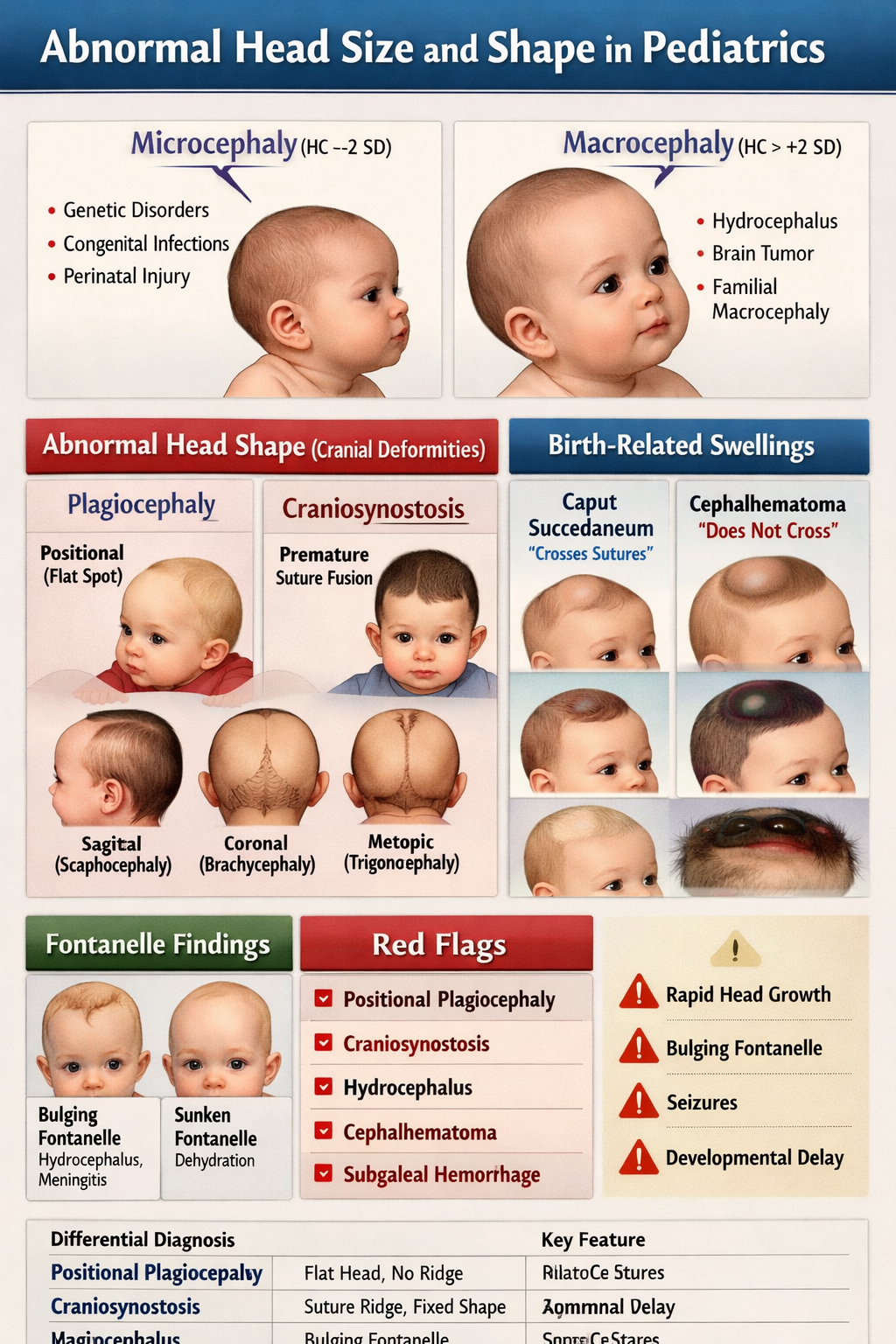
9. HEAD SWELLINGS IN NEWBORN
Newborn scalp swellings are common after delivery.
1. CAPUT SUCCEDANEUM
Definition
Edema of scalp due to pressure during labor.
Features
- Present at birth
- Soft swelling
- Crosses suture lines
- Resolves in 1–2 days
Complications
- None
2. CEPHALHEMATOMA
Definition
Bleeding under periosteum of skull bone.
Features
- Appears after few hours
- Firm swelling
- Does NOT cross suture lines
- Confined to one bone (parietal)
Complications
- Jaundice (bilirubin from blood breakdown)
- Anemia
- Calcification
3. SUBGALEAL HEMORRHAGE
Definition
Bleeding in potential space between scalp and skull.
Features
- Diffuse fluctuant swelling
- Crosses sutures and midline
- Can expand rapidly
Serious Complications
- Massive blood loss → shock
- Life-threatening emergency
Requires:
- ICU monitoring
- Blood transfusion if severe
✅ SUMMARY TABLE: HEAD SWELLINGS
| Feature | Caput | Cephalhematoma | Subgaleal Hemorrhage |
| ---------------- | ----------- | ------------------- | -------------------- |
| Layer | Scalp edema | Subperiosteal bleed | Subaponeurotic bleed |
| Crosses sutures? | Yes | No | Yes |
| Onset | At birth | Hours later | Progressive |
| Risk | Benign | Jaundice | Shock, death |