✅ NEONATAL REFLEXES, HIE, AND NEONATAL SEIZURES (DETAILED)
1. NEONATAL REFLEXES
Definition
Neonatal reflexes are primitive automatic motor responses mediated by the brainstem/spinal cord, present at birth and gradually disappear as cortical control develops.
Importance
They help assess:
- CNS maturity
- Neurological integrity
- Presence of brain injury (e.g., HIE)
- Peripheral nerve injury
Major Neonatal Reflexes
1. Moro Reflex (Startle Reflex)
Method
Sudden head drop → infant abducts arms then adducts.
Normal Age
- Present: Birth
- Disappears: 4–6 months
Abnormal
- Absent: CNS depression, HIE, prematurity
- Asymmetrical: Brachial plexus injury, clavicle fracture
2. Rooting Reflex
Method
Stroke cheek → infant turns head toward stimulus.
Normal Age
- Present: Birth
- Disappears: 3–4 months
Absent
- Severe CNS depression
- Sedation
- HIE
3. Sucking Reflex
Method
Touch palate → rhythmic sucking.
Normal Age
- Present: 32–34 weeks GA
- Mature: Term
- Disappears: 4 months
Absent
- Prematurity
- CNS injury
- HIE
4. Palmar Grasp Reflex
Method
Finger in palm → infant grasps.
Normal Age
- Disappears: 4–6 months
Persistent
- Cerebral palsy
5. Plantar Grasp Reflex
Method
Pressure on sole → toe flexion.
Disappears
- 9–12 months
6. Stepping Reflex
Method
Hold upright → stepping movements.
Disappears
- 2 months
7. Tonic Neck Reflex (Fencing posture)
Method
Turn head → ipsilateral arm extends.
Disappears
- 5–6 months
Persistent
- Cerebral palsy
8. Babinski Reflex
Normal
Toe extension up to 1 year
2. HYPOXIC ISCHEMIC ENCEPHALOPATHY (HIE)
Definition
HIE is brain injury due to reduced oxygen + reduced cerebral blood flow around birth.
Pathophysiology
Perinatal hypoxia → ↓ATP → neuronal injury via:
- Excitotoxicity (glutamate)
- Calcium influx
- Free radical injury
- Apoptosis
Phases:
- Primary energy failure
- Latent phase (6 hrs)
- Secondary energy failure (seizures, edema)
Causes / Risk Factors
Antepartum
- Placental insufficiency
- Severe maternal hypotension
- Preeclampsia
Intrapartum
- Prolonged labor
- Cord prolapse
- Placental abruption
- Uterine rupture
Postnatal
- Shock
- Severe respiratory failure
Clinical Features
Early Signs
- Low Apgar (<5 at 5 min)
- Poor tone
- Weak cry
- Poor feeding
- Altered consciousness
Sarnat Staging
| Stage | Features | Prognosis |
| ----------- | ------------------------------------ | --------- |
| I Mild | Hyperalert, jittery, normal reflexes | Good |
| II Moderate | Lethargy, hypotonia, seizures common | Variable |
| III Severe | Coma, absent reflexes, apnea | Poor |
Investigations
Blood Tests
- ABG: metabolic acidosis
- Lactate ↑
- Glucose, Ca²⁺, Mg²⁺
Neuroimaging
- Cranial US: early screening
- MRI (best): basal ganglia injury
EEG/aEEG
- Background suppression = severe injury
- Seizure detection
Management of HIE
1. Therapeutic Hypothermia (Main Treatment)
Indication
Moderate–severe HIE within 6 hours of birth
Method
Cooling to 33–34°C for 72 hrs
Benefits
Reduces death + neurodisability
2. Supportive Management
- Maintain oxygenation/ventilation
- Treat hypotension (dopamine/dobutamine)
- Maintain glucose 70–150 mg/dL
- Correct electrolytes
- Manage seizures
Drugs in HIE
Phenobarbital
- Indication: first-line seizures in HIE
- MOA: enhances GABA inhibition
- Dose:
* Load: 20 mg/kg IV
* Additional: 10 mg/kg
* Maintenance: 3–4 mg/kg/day
- Adverse effects: sedation, respiratory depression
- Monitoring: RR, BP, serum levels
- Counseling: may cause drowsiness
3. NEONATAL SEIZURES
Definition
Paroxysmal abnormal electrical brain activity in newborns, often subtle.
Why Important
Neonatal seizures are often a symptom of serious brain injury (HIE most common).
Common Causes
Most Common
- Hypoxic ischemic encephalopathy
Metabolic
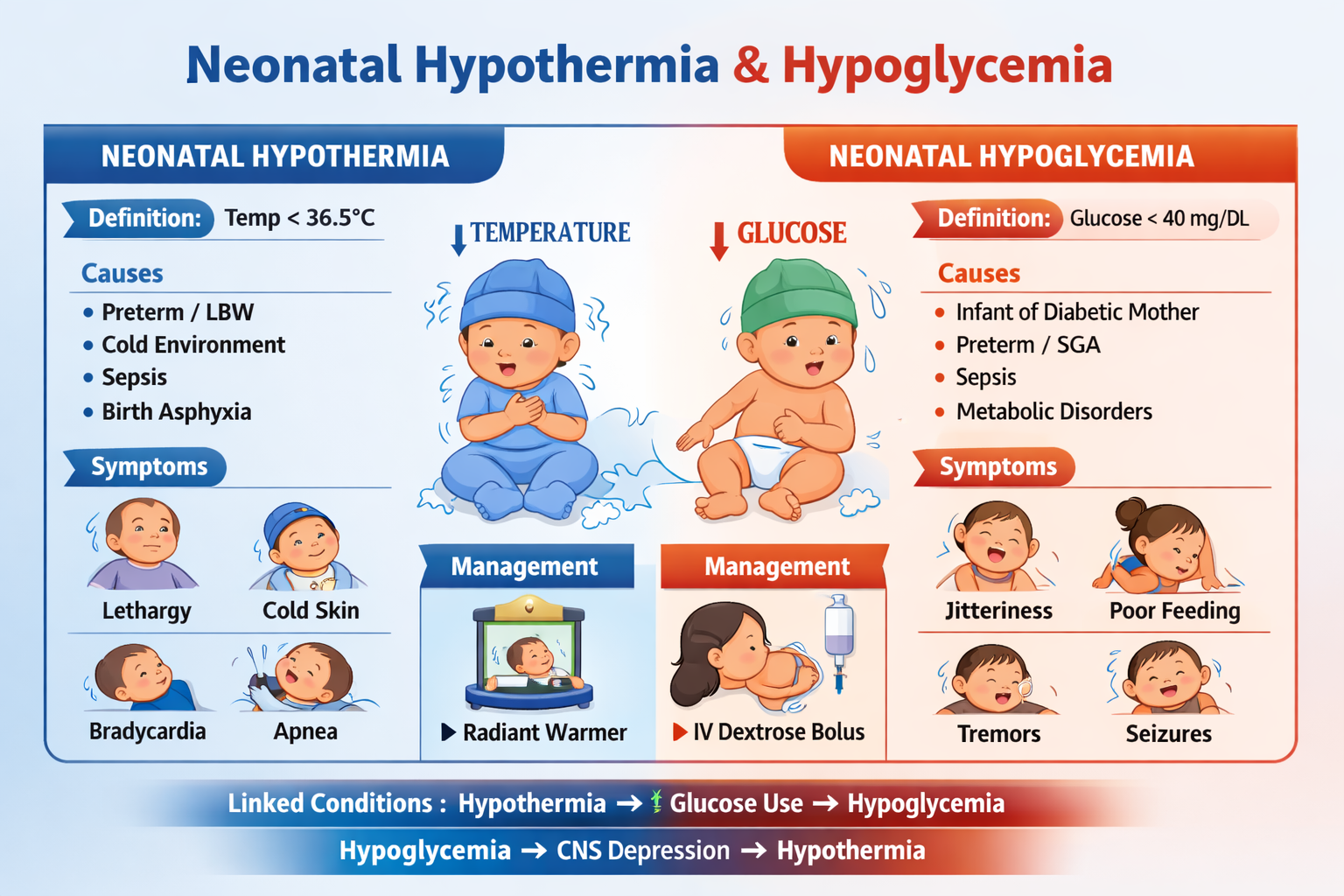
- Hypoglycemia
- Hypocalcemia
- Hypomagnesemia
Infection
- Meningitis, sepsis
Structural
- Intracranial hemorrhage
- Stroke
Genetic
- Benign familial neonatal seizures
Types of Neonatal Seizures
1. Subtle (Most common)
- Eye deviation
- Lip smacking
- Pedaling movements
- Apnea episodes
2. Clonic
- Rhythmic jerking (focal)
3. Tonic
- Sustained limb extension
4. Myoclonic
- Sudden jerks (poor prognosis)
Diagnosis
Stepwise Approach
- Check glucose immediately
- Serum Ca²⁺, Mg²⁺, Na⁺
- Sepsis workup
- EEG confirmation
- MRI brain
Management of Neonatal Seizures
Emergency Stabilization
- ABC (Airway, Breathing, Circulation)
- Oxygen + IV access
- Correct hypoglycemia first
Treat Underlying Cause
Hypoglycemia
- Dextrose bolus 2 mL/kg of 10%
Hypocalcemia
- Calcium gluconate 10%: 2 mL/kg slow IV
Antiseizure Drugs
1. Phenobarbital (First line)
Same dosing as above.
2. Levetiracetam (Second line, increasingly used)
- MOA: SV2A modulation
- Dose:
* Load: 40–60 mg/kg IV
* Maintenance: 20–30 mg/kg/day
- Advantages: less respiratory depression
- Adverse effects: irritability, somnolence
- Monitoring: renal function
3. Phenytoin/Fosphenytoin
- MOA: Na channel blockade
- Dose: Load 15–20 mg/kg IV
- Adverse effects: arrhythmias, hypotension
- Monitoring: ECG during infusion
Prognosis
Depends on cause:
- Metabolic seizures → excellent outcome
- HIE with severe EEG suppression → poor
- Structural brain lesions → variable
✅ KEY DIFFERENCES: HIE vs Seizures
| Feature | HIE | Neonatal Seizures |
| --------------- | -------------------------- | --------------------- |
| Primary problem | Global hypoxic injury | Symptom of CNS insult |
| Common sign | Altered tone + reflex loss | Subtle jerks, apnea |
| Main therapy | Hypothermia | Anticonvulsants |
| Prognosis | Depends on severity | Depends on etiology |
⭐ QUICK EXAM PEARLS
- Absent Moro + poor suck = CNS depression/HIE
- Seizures in first 24 hrs → HIE most likely
- Always correct glucose before anticonvulsants
- EEG is gold standard for neonatal seizures
- Hypothermia only works if started <6 hrs