Disorders of Development in Pediatrics (Detailed)
1. Definition
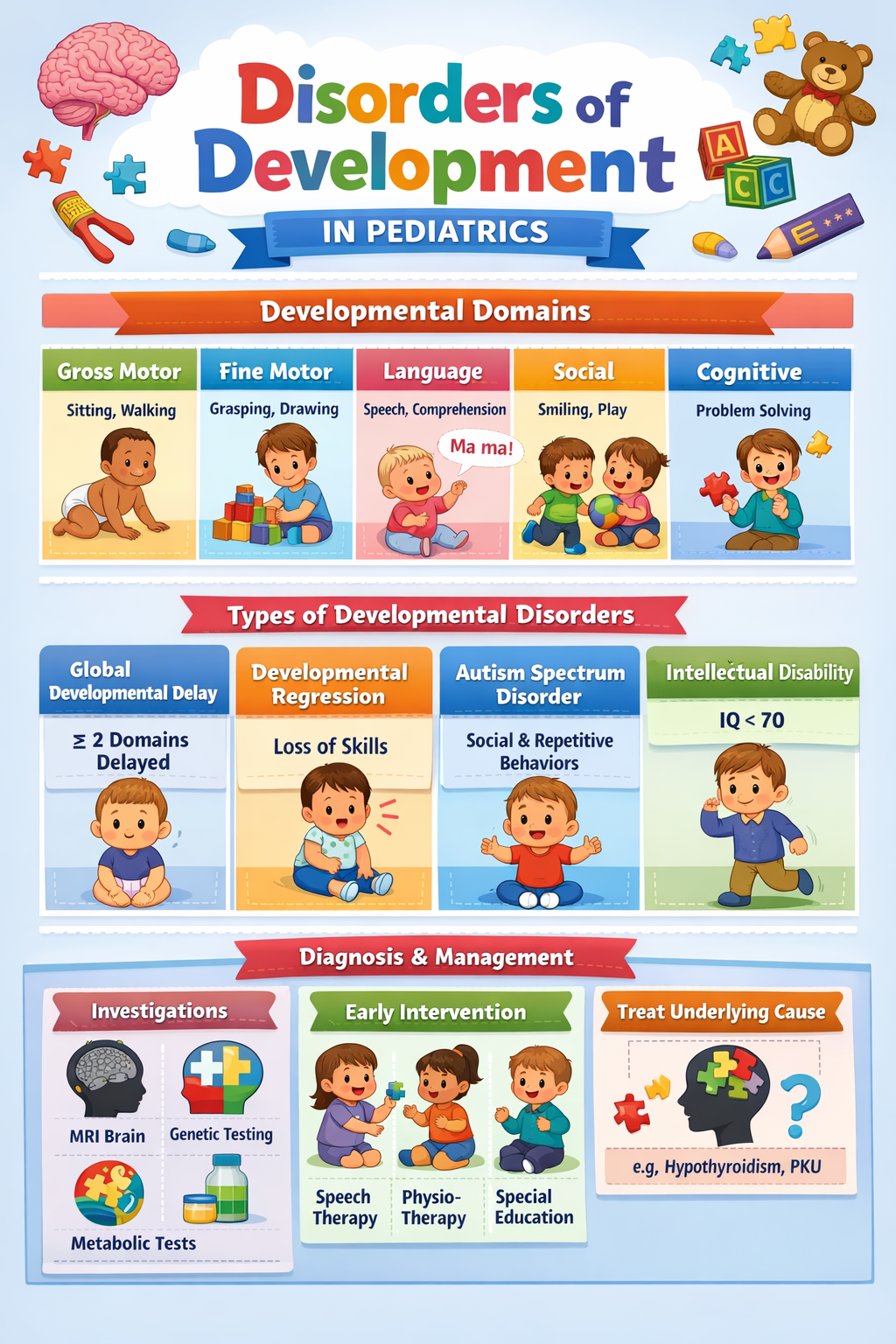
A developmental disorder is a condition in which a child fails to achieve expected developmental milestones at the appropriate age.
Development includes:
- Gross motor
- Fine motor–adaptive
- Language (speech + comprehension)
- Social–personal
- Cognitive development
2. Normal Development Domains
| Domain | Examples |
| ----------- | -------------------------------- |
| Gross Motor | Sitting, walking, running |
| Fine Motor | Grasping, drawing, pincer grip |
| Language | Babbling, first words, sentences |
| Social | Smiling, stranger anxiety, play |
| Cognitive | Problem solving, learning |
3. Classification of Developmental Disorders
A. Developmental Delay
Delay in achieving milestones compared with peers.
Types:
- Isolated delay (one domain)
- Global developmental delay (GDD) (≥2 domains affected)
B. Developmental Regression
Loss of previously acquired milestones.
⚠️ Always pathological.
Common causes:
- Neurodegenerative disorders
- Autism spectrum disorder
- Metabolic disorders
C. Intellectual Disability (ID)
Deficits in:
- Intellectual functioning (IQ <70)
- Adaptive behavior
- Onset before 18 years
D. Autism Spectrum Disorder (ASD)
Neurodevelopmental disorder with:
- Social communication impairment
- Restricted repetitive behaviors
E. Specific Developmental Disorders
- Specific learning disorder
- Speech/language disorder
- Developmental coordination disorder
4. Etiology (Causes)
Prenatal Causes
- Genetic syndromes (Down syndrome, Fragile X)
- Congenital infections (TORCH)
- Maternal alcohol/drug exposure
- Neural tube defects
Perinatal Causes
- Birth asphyxia (HIE)
- Prematurity complications
- Intracranial hemorrhage
Postnatal Causes
- CNS infections (meningitis, encephalitis)
- Head injury
- Malnutrition
- Environmental deprivation
Metabolic & Neurodegenerative Causes
- Hypothyroidism
- Phenylketonuria
- Leukodystrophies
5. Risk Factors
- Prematurity
- Low birth weight
- Family history of developmental disorders
- Consanguinity
- Poor socioeconomic stimulation
- Chronic illness
6. Clinical Presentation
Red Flags in Development
🚩 No social smile by 3 months
🚩 No head control by 4 months
🚩 Not sitting by 9 months
🚩 No single words by 16 months
🚩 No walking by 18 months
🚩 Loss of skills at any age
🚩 No two-word phrases by 2 years
7. Approach to a Child with Developmental Delay
Step 1: Detailed History
Prenatal
- Infections, drugs, alcohol
Birth History
- Asphyxia, NICU stay
Developmental History
- Milestone charting
Family History
- Genetic disorders, delays
Step 2: Physical Examination
- Growth parameters (HC, weight, height)
- Dysmorphic features
- Neurocutaneous markers (NF, TS)
- Tone abnormalities
- Vision/hearing assessment
Step 3: Developmental Screening Tools
- Denver Developmental Screening Test (DDST)
- Ages and Stages Questionnaire (ASQ)
- M-CHAT (Autism screening)
8. Investigations
Baseline Tests
- Hearing assessment (BERA/OAE)
- Vision screening
- Thyroid function test (TSH, T4)
- CBC, iron studies
Neuroimaging
MRI Brain if:
- Regression
- Seizures
- Abnormal head size
- Focal neurological signs
Genetic Testing
- Karyotype (Down syndrome)
- Fragile X testing
- Chromosomal microarray
Metabolic Workup
If unexplained regression:
- Serum ammonia
- Lactate
- Tandem mass spectrometry
- Urine organic acids
9. Differential Diagnosis
| Condition | Key Features |
| -------------------------- | ---------------------------------------- |
| Cerebral palsy | Motor delay, spasticity, non-progressive |
| ASD | Social deficit + repetitive behaviors |
| Hearing impairment | Speech delay only |
| Intellectual disability | Cognitive + adaptive impairment |
| Hypothyroidism | Lethargy, constipation, poor growth |
| Neurodegenerative disorder | Regression, seizures |
10. Management (Stepwise)
Principles
Early identification + early intervention is critical.
A. General Management
1. Early Intervention Programs
- Physiotherapy
- Occupational therapy
- Speech therapy
- Special education
2. Parent Counseling
- Explain diagnosis sensitively
- Encourage stimulation at home
- Support groups
3. Treat Underlying Cause
Examples:
- Congenital hypothyroidism → Levothyroxine
- PKU → Dietary phenylalanine restriction
B. Domain-Specific Therapy
Gross Motor Delay
- Physiotherapy
- Orthopedic support
Speech Delay
- Speech therapy
- Hearing correction
Social Delay/Autism
- ABA therapy
- Structured routines
11. Pharmacologic Treatment (When Needed)
Drugs do NOT cure developmental delay but treat associated conditions.
1. ADHD Symptoms
Methylphenidate
- Indication: Hyperactivity, impulsivity
- MOA: ↑ dopamine/norepinephrine
- Dose: 0.3–1 mg/kg/day
- Side effects: Appetite loss, insomnia
- Monitoring: Growth, BP, HR
2. Seizures
Valproate / Levetiracetam
- Used if epilepsy present
- Monitoring: LFTs (valproate)
3. Autism Irritability
Risperidone
- Dose: 0.25–1 mg/day
- Side effects: Weight gain, sedation
- Monitoring: BMI, glucose, lipids
12. Prognosis
Depends on:
- Severity
- Cause (reversible vs degenerative)
- Early therapy initiation
- Family support
Better outcomes in:
- Isolated speech delay
- Early-treated hypothyroidism
Poor outcomes in:
- Neurodegenerative regression
13. Prevention
- Antenatal care
- Folic acid supplementation
- Newborn screening programs
- Immunization
- Early hearing screening
- Avoid alcohol/drugs in pregnancy
Key Exam Points (High Yield)
- Regression = always abnormal
- Global delay = ≥2 domains affected
- Hearing loss is a common cause of speech delay
- Early intervention improves outcomes
- MRI + Genetic testing important in unexplained GDD