Brachial Plexus – Complete Detailed Anatomy
Definition
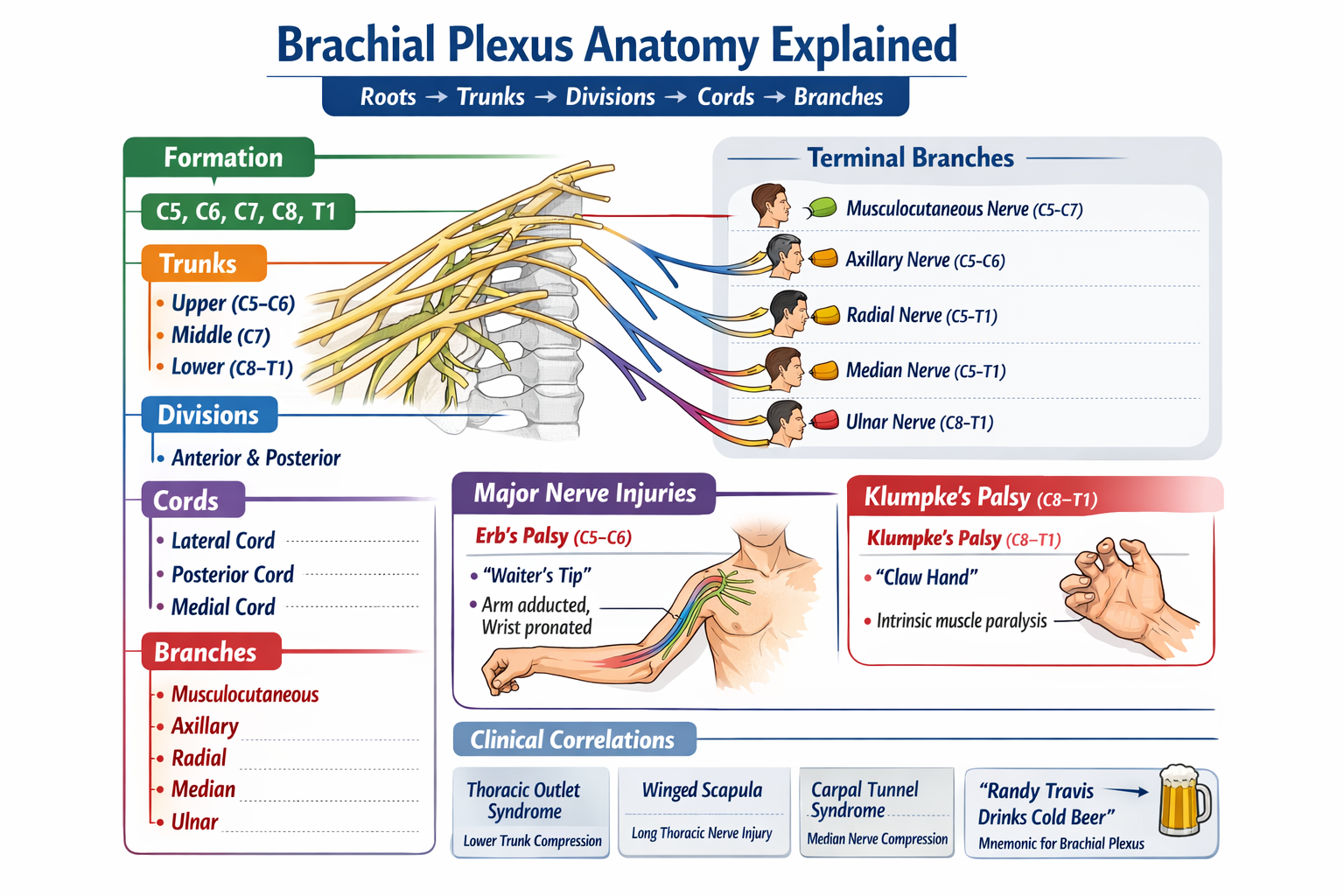
The brachial plexus is a network of ventral rami of spinal nerves C5–T1 that provides motor, sensory, and sympathetic innervation to the upper limb.
Formation (Roots → Trunks → Divisions → Cords → Branches)
1. Roots
- C5, C6, C7, C8, T1 (ventral rami)
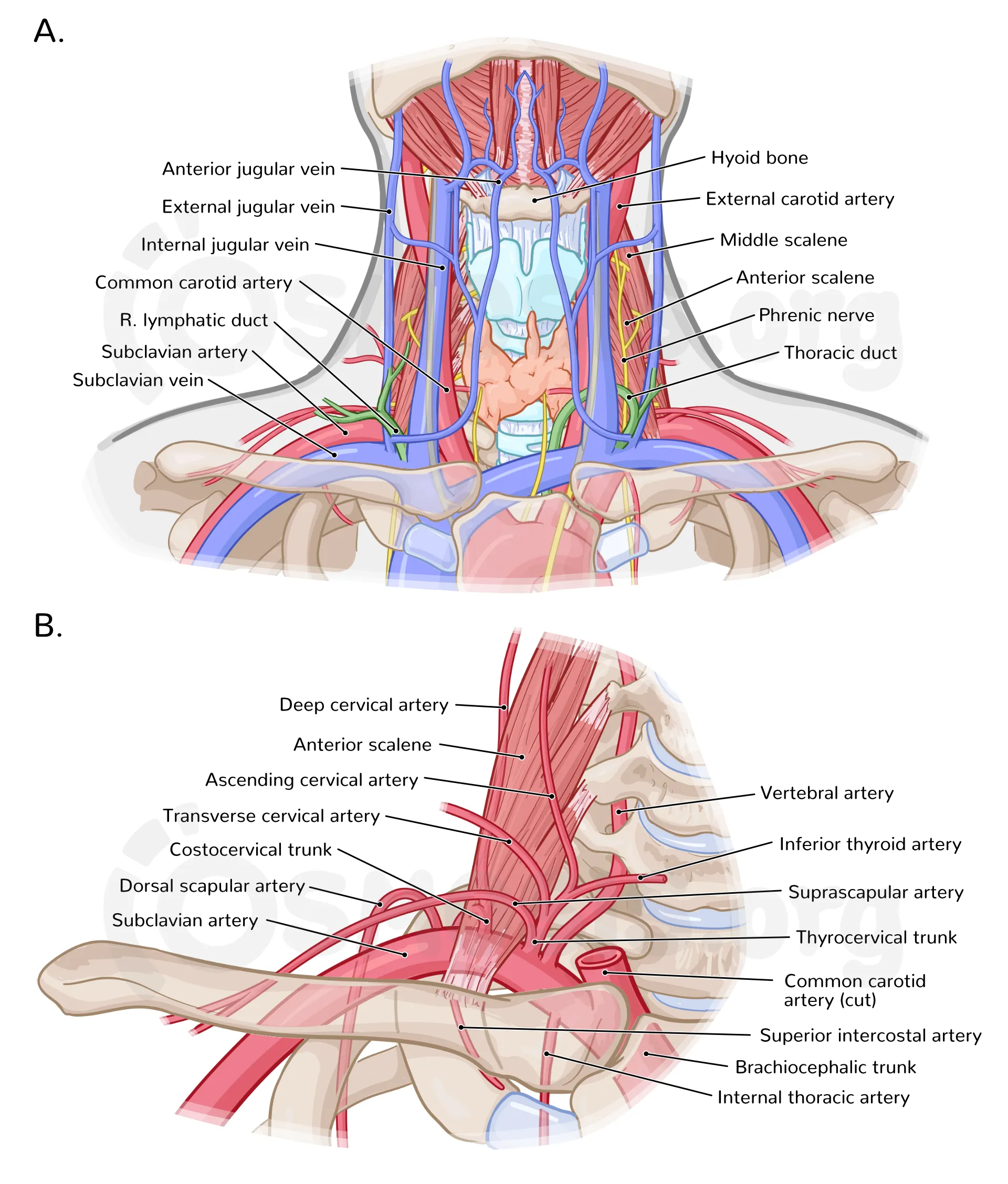
- Pass between anterior and middle scalene muscles in the neck
- Branches from roots:
* Dorsal scapular nerve (C5) → Rhomboids, levator scapulae
* Long thoracic nerve (C5–C7) → Serratus anterior (winged scapula if injured)
2. Trunks
Formed in the posterior triangle of the neck
- Upper trunk: C5–C6
- Middle trunk: C7
- Lower trunk: C8–T1
Branches from trunks:
- Suprascapular nerve (C5–C6) → Supraspinatus, infraspinatus
- Nerve to subclavius (C5–C6)
3. Divisions
Located behind the clavicle
- Each trunk divides into:
* Anterior division → Flexor compartments
* Posterior division → Extensor compartments
- No branches arise here
4. Cords
Named according to relation to the axillary artery (in axilla)
| Cord | Formation |
| ------------------ | ------------------------------------------- |
| Lateral cord | Anterior divisions of upper + middle trunks |
| Medial cord | Anterior division of lower trunk |
| Posterior cord | All posterior divisions |
5. Terminal Branches
From Lateral Cord
- Musculocutaneous nerve (C5–C7)
- Lateral root of median nerve
From Medial Cord
- Ulnar nerve (C8–T1)
- Medial root of median nerve
- Medial cutaneous nerve of arm
- Medial cutaneous nerve of forearm
From Posterior Cord
- Axillary nerve (C5–C6)
- Radial nerve (C5–T1)
Major Peripheral Nerves – Functions & Lesions
Musculocutaneous Nerve (C5–C7)
- Motor: Biceps, brachialis, coracobrachialis
- Sensory: Lateral forearm
- Injury: Weak elbow flexion & supination
Axillary Nerve (C5–C6)
- Motor: Deltoid, teres minor
- Sensory: Regimental badge area
- Injury: Surgical neck fracture → loss of shoulder abduction (15–90°)
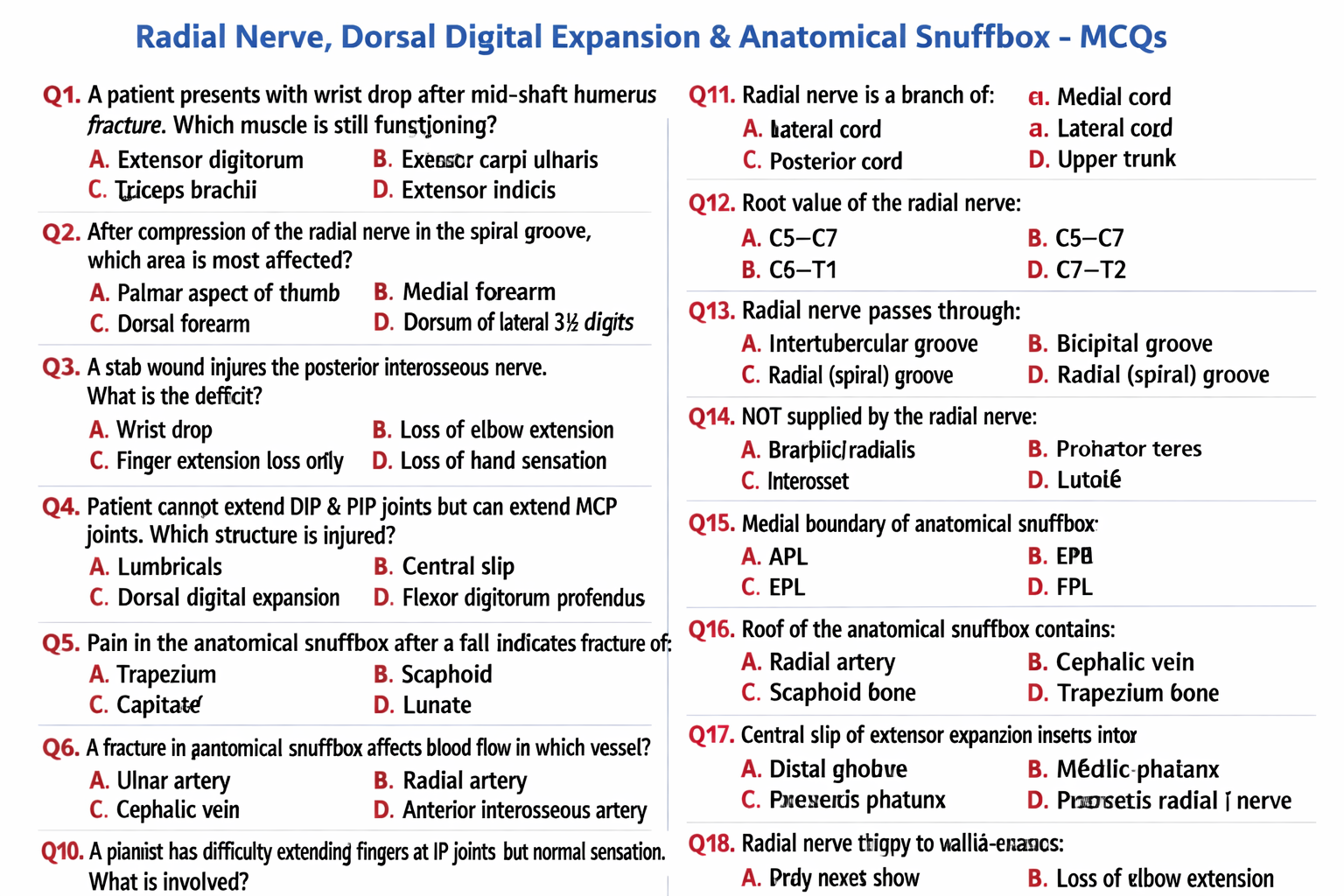
Radial Nerve (C5–T1)
- Motor: All extensors of arm & forearm
- Sensory: Posterior arm, forearm, dorsal hand
- Injury: Wrist drop
Median Nerve (C5–T1)
- Motor: Forearm flexors, thenar muscles
- Sensory: Lateral 3½ digits (palmar)
- Injury: Ape hand, loss of pronation, carpal tunnel syndrome
Ulnar Nerve (C8–T1)
- Motor: Intrinsic hand muscles
- Sensory: Medial 1½ fingers
- Injury: Claw hand, Froment sign
Clinical Correlations
Upper Trunk Lesion (Erb Palsy – C5–C6)
- Causes: Birth injury, fall on shoulder
- Deformity: “Waiter’s tip”
- Affected nerves: Axillary, musculocutaneous, suprascapular
Lower Trunk Lesion (Klumpke Palsy – C8–T1)
- Causes: Traction of abducted arm
- Features:
* Intrinsic hand muscle paralysis
* Claw hand
* Horner syndrome (if T1 sympathetic affected)
Applied Anatomy
- Scalene block anesthesia targets roots/trunks
- Axillary block targets terminal branches
- Thoracic outlet syndrome affects lower trunk
- Winged scapula → Long thoracic nerve injury
Key Exam Mnemonic
Roots → Trunks → Divisions → Cords → Branches
“Randy Travis Drinks Cold Beer”