Basal Ganglia
Introduction
The basal ganglia are a group of deep subcortical nuclei in the cerebral hemispheres that play a critical role in motor control, posture, muscle tone, procedural learning, cognition, and emotion. They modulate motor activity rather than initiating movement and are essential for smooth, coordinated voluntary actions.
Definition
Basal ganglia are interconnected collections of grey matter nuclei located deep within the brain that regulate movement initiation, inhibition, and coordination, along with behavioral and cognitive functions.
Components of Basal Ganglia
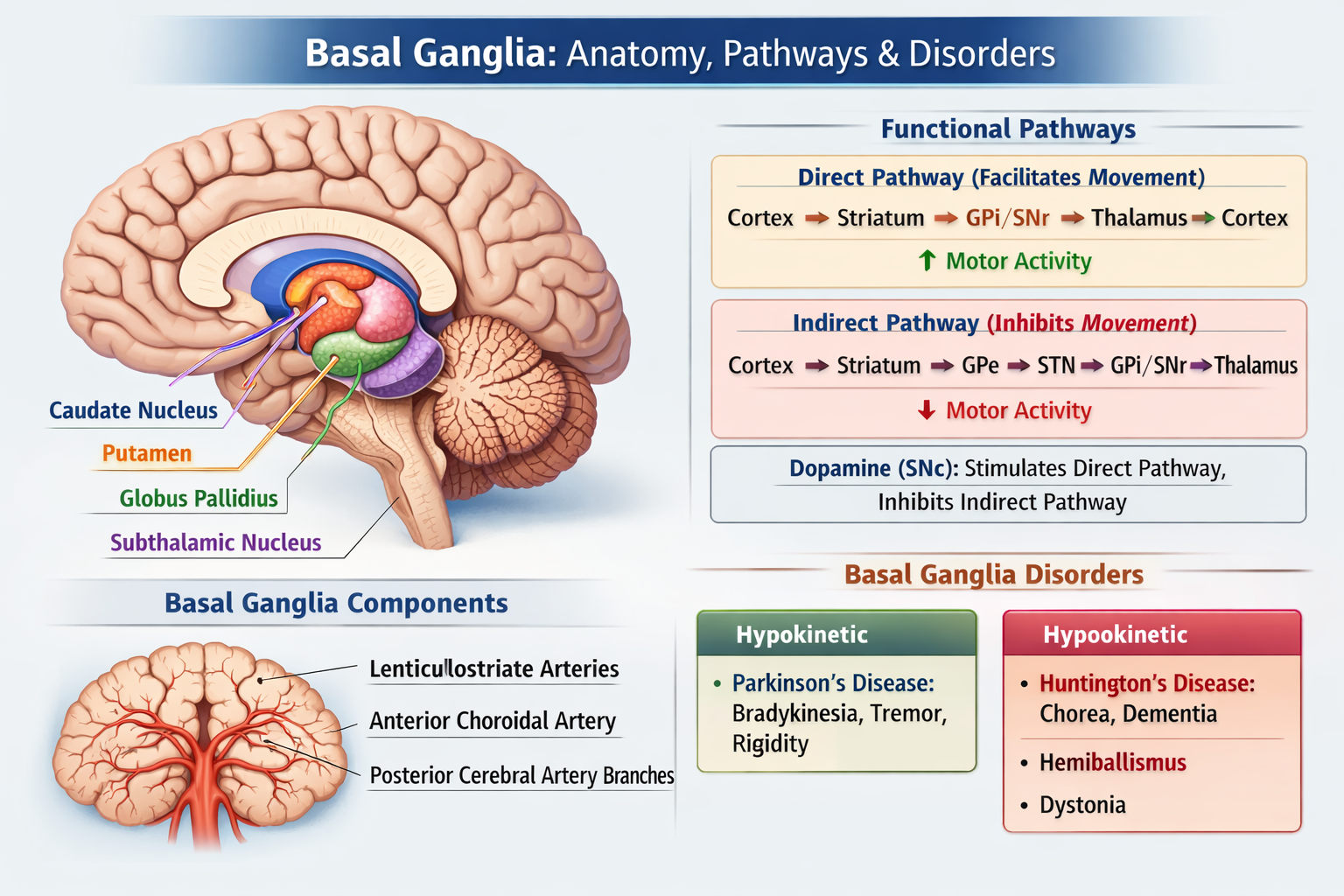
Anatomical Nuclei
- Corpus striatum
* Caudate nucleus
* Putamen
- Globus pallidus
* External segment (GPe)
* Internal segment (GPi)
- Subthalamic nucleus
- Substantia nigra
* Pars compacta (SNc)
* Pars reticulata (SNr)
Functional Classification
- Input nuclei: Caudate nucleus, Putamen
- Output nuclei: Globus pallidus internus (GPi), Substantia nigra pars reticulata
- Intrinsic nuclei: Globus pallidus externus, Subthalamic nucleus, Substantia nigra pars compacta
Location
- Situated deep within cerebral hemispheres
- Lateral to the thalamus
- Surrounding the internal capsule
- Substantia nigra lies in the midbrain
Connections of Basal Ganglia
Afferent (Input)
- Cerebral cortex → Striatum (glutamatergic, excitatory)
- Substantia nigra pars compacta → Striatum (dopaminergic)
Efferent (Output)
- GPi / SNr → Thalamus → Motor cortex
Functional Pathways
1. Direct Pathway (Facilitates Movement)
- Cortex → Striatum → GPi/SNr → Thalamus → Cortex
- Net effect: Increases motor activity
2. Indirect Pathway (Inhibits Movement)
- Cortex → Striatum → GPe → Subthalamic nucleus → GPi/SNr → Thalamus
- Net effect: Decreases motor activity
3. Dopaminergic Modulation
- Dopamine from SNc:
* Stimulates direct pathway (D1 receptors)
* Inhibits indirect pathway (D2 receptors)
- Overall effect: Promotes movement
Functions of Basal Ganglia
- Initiation and termination of voluntary movements
- Regulation of muscle tone
- Control of posture and balance
- Suppression of unwanted movements
- Procedural learning and habit formation
- Emotional and cognitive regulation (via limbic circuits)
Blood Supply
- Lenticulostriate arteries (branches of Middle Cerebral Artery)
- Anterior choroidal artery
- Posterior cerebral artery branches (subthalamic nucleus)
Clinical Correlation (Basal Ganglia Disorders)
Hypokinetic Disorders
- Parkinson disease
* Degeneration of substantia nigra pars compacta
* Bradykinesia, rigidity, resting tremor, postural instability
Hyperkinetic Disorders
- Huntington disease
* Degeneration of caudate nucleus
* Chorea, behavioral changes, dementia
- Hemiballismus
* Lesion of subthalamic nucleus
* Violent flinging movements
- Dystonia
* Sustained muscle contractions
Role in Motor Control
Basal ganglia do not directly control motor neurons. Instead, they influence motor activity by modulating cortical motor areas via the thalamus, ensuring smooth, purposeful movement.