Medical Disclaimer: This is educational content only, not medical advice. Consult a licensed healthcare provider for diagnosis/treatment. Information based on sources like WHO/CDC guidelines (last reviewed: 2026-02-13).
This article is being expanded for more depth. Check back soon!
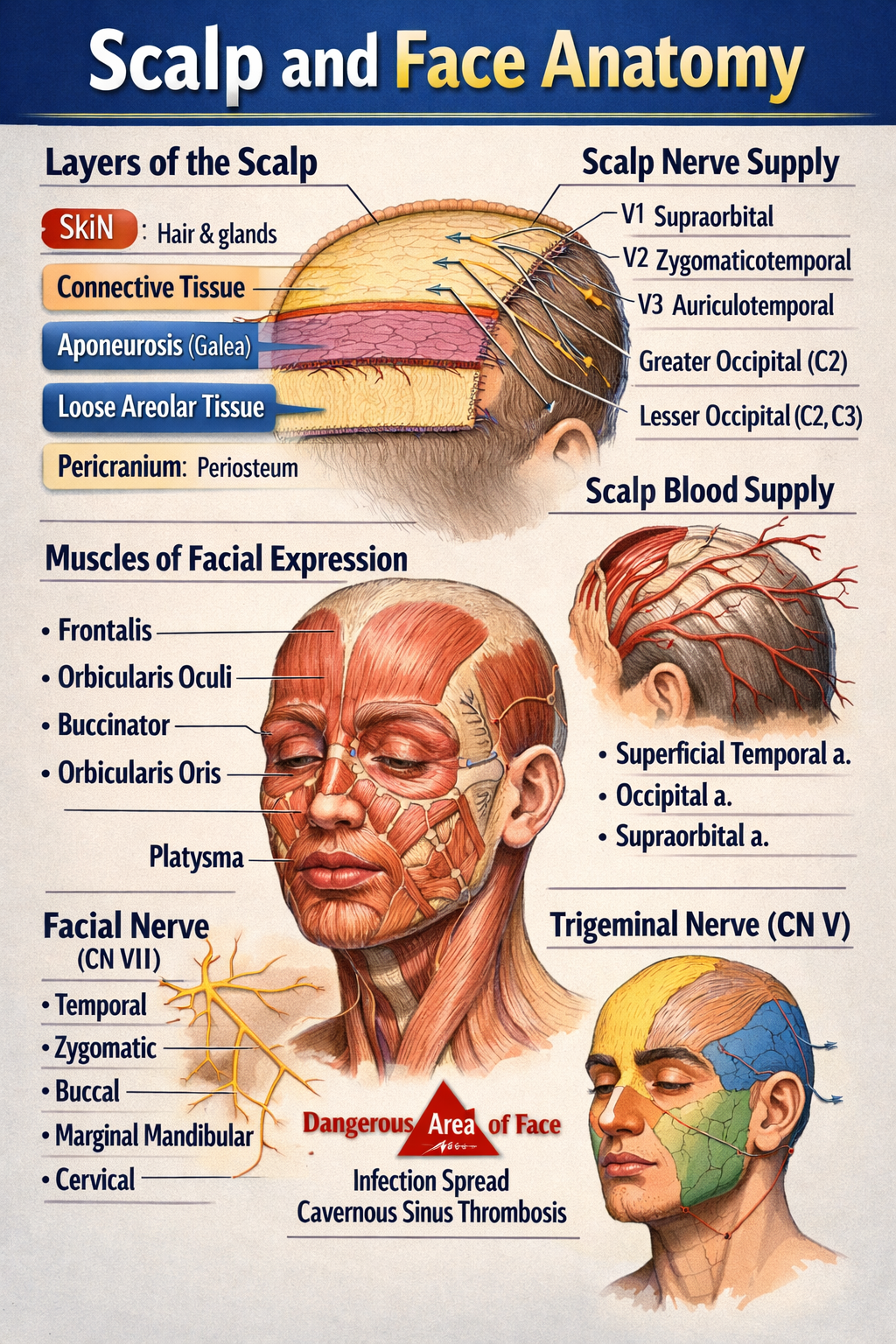
Scalp and Face Anatomy Complete Structure Nerves Blood Supply and Clinical Correlation
Frequently Asked Questions
What is the scalp in anatomy?
The scalp is the soft tissue covering the cranial vault, extending from the supraorbital margins anteriorly to the superior nuchal lines posteriorly and laterally to the zygomatic arches.
What are the five layers of the scalp?
The five layers of the scalp are Skin, dense Connective tissue, Aponeurosis (galea aponeurotica), Loose areolar tissue, and Pericranium.
Why does the scalp bleed profusely after injury?
The scalp bleeds profusely because blood vessels are located in the dense connective tissue layer where they are firmly fixed and cannot retract after injury.
Which layer is known as the danger area of the scalp?
The loose areolar tissue layer is known as the danger area of the scalp because it contains emissary veins that can spread infection to intracranial venous sinuses.
What muscle connects the frontal and occipital regions of the scalp?
The occipitofrontalis muscle connects the frontal and occipital regions of the scalp via the galea aponeurotica.
Which nerve supplies the muscles of the scalp?
The muscles of the scalp are supplied by the facial nerve, specifically its temporal and posterior auricular branches.
What is the main sensory nerve supply of the face?
The main sensory nerve supply of the face is provided by the trigeminal nerve through its ophthalmic, maxillary, and mandibular divisions.
Which nerve supplies the muscles of facial expression?
The muscles of facial expression are supplied by the facial nerve.
What is the dangerous area of the face?
The dangerous area of the face includes the upper lip, nose, and medial cheek, where infection can spread to the cavernous sinus through venous connections.
Why is infection in the central face considered dangerous?
Infection in the central face is dangerous because veins in this area communicate with the cavernous sinus, allowing potential intracranial spread of infection.
What artery is the main arterial supply of the face?
The facial artery, a branch of the external carotid artery, is the main arterial supply of the face.
What is cephalhematoma?
Cephalhematoma is a subperiosteal hemorrhage in newborns that is limited by cranial suture lines.
What is caput succedaneum?
Caput succedaneum is a diffuse edema of the scalp seen in newborns that crosses suture lines.
Which vein connects the facial vein to the cavernous sinus?
The angular vein connects the facial vein to the cavernous sinus through the ophthalmic veins.
What causes facial nerve palsy?
Facial nerve palsy is caused by damage to the facial nerve and results in paralysis of the muscles of facial expression on the affected side.
MCQ Test - Scalp and Face Anatomy Complete Structure Nerves Blood Supply and Clinical Correlation
Progress:
0/0
Time: 00:00
No MCQs available for this article.