Medical Disclaimer: This is educational content only, not medical advice. Consult a licensed healthcare provider for diagnosis/treatment. Information based on sources like WHO/CDC guidelines (last reviewed: 2026-02-13).
This article is being expanded for more depth. Check back soon!
Glands of Head and Neck Anatomy Types Functions and Clinical Importance
Frequently Asked Questions
What are the main glands of the head and neck?
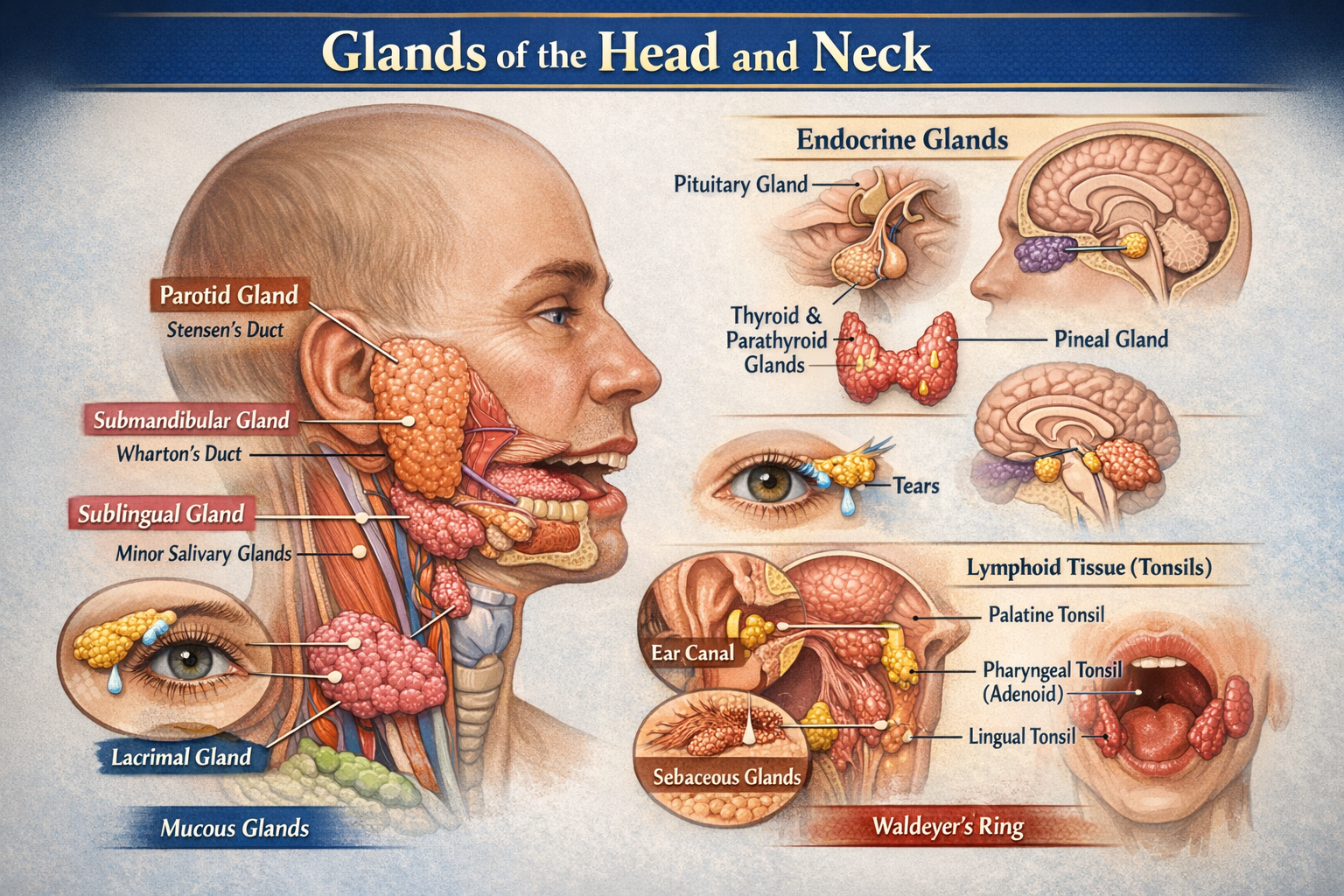
The main glands of the head and neck include the major salivary glands (parotid, submandibular, sublingual), minor salivary glands, endocrine glands (thyroid, parathyroid, pituitary, pineal), lacrimal glands, sebaceous glands, ceruminous glands, and lymphoid glands such as the tonsils.
Which is the largest salivary gland in the head and neck?
The parotid gland is the largest salivary gland in the head and neck and is predominantly a serous gland.
Which nerve supplies parasympathetic fibers to the parotid gland?
The parasympathetic secretomotor supply to the parotid gland is provided by the glossopharyngeal nerve via the lesser petrosal nerve and otic ganglion.
Which salivary gland is most commonly affected by salivary stones?
The submandibular gland is most commonly affected by salivary stones due to the long and upward course of Wharton duct and thicker saliva.
What is the function of the sublingual gland?
The sublingual gland primarily secretes mucous saliva that helps in lubrication of the oral cavity and facilitation of swallowing.
What hormones are secreted by the thyroid gland?
The thyroid gland secretes thyroxine (T4), triiodothyronine (T3), and calcitonin, which regulate metabolism, growth, and calcium homeostasis.
Why is hypocalcemia seen after thyroid surgery?
Hypocalcemia after thyroid surgery occurs due to accidental removal or damage to the parathyroid glands, leading to reduced parathyroid hormone secretion.
What is the role of the pituitary gland in the head and neck?
The pituitary gland acts as the master endocrine gland by regulating growth, metabolism, reproduction, stress response, and the activity of other endocrine glands.
Which gland regulates circadian rhythm?
The pineal gland regulates circadian rhythm by secreting the hormone melatonin.
What is the function of ceruminous glands?
Ceruminous glands are modified apocrine sweat glands in the external auditory canal that produce cerumen (ear wax) to protect and lubricate the ear canal.
Which gland produces tears?
The lacrimal gland produces tears that lubricate the eye, remove debris, and provide antimicrobial protection.
What are minor salivary glands and where are they located?
Minor salivary glands are small mucous-secreting glands located in the lips, cheeks, tongue, soft palate, and oropharynx.
Which salivary gland tumors are most likely to be malignant?
Tumors of minor salivary glands are most likely to be malignant compared to major salivary glands.
What is a ranula and which gland is involved?
A ranula is a mucous retention cyst arising from the sublingual gland in the floor of the mouth.
What are tonsils and what is their function?
Tonsils are lymphoid glandular structures forming Waldeyer ring and play a role in immune defense by trapping and responding to pathogens entering through the oral and nasal cavities.
MCQ Test - Glands of Head and Neck Anatomy Types Functions and Clinical Importance
Progress:
0/0
Time: 00:00
No MCQs available for this article.