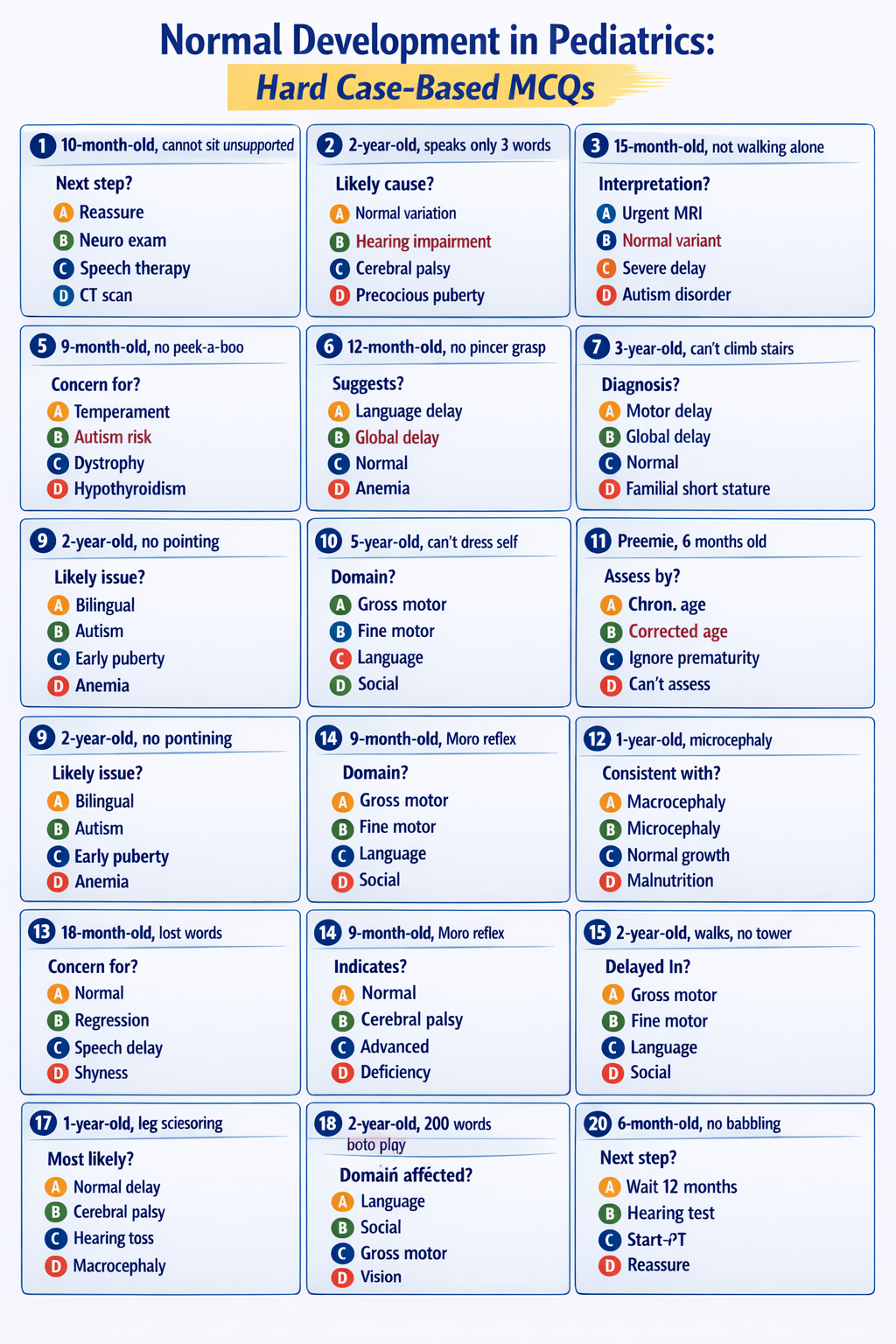
Normal Development in Paediatrics
Normal child development refers to the progressive acquisition of physical, motor, cognitive, language, emotional, and social abilities from birth through adolescence. Development follows a predictable sequence, though the exact timing may vary among children.
1. Principles of Normal Development
1. Cephalocaudal Principle
Development progresses from head to toe.
Example:
- Head control develops before sitting
- Sitting develops before walking
2. Proximodistal Principle
Development progresses from central to peripheral parts of the body.
Example:
- Shoulder control before hand control
- Whole hand grasp before pincer grasp
3. Sequential Pattern
Development occurs in a fixed order, although the age may vary.
Example:
- Roll → Sit → Crawl → Stand → Walk
4. Continuous Process
Development occurs continuously but at different rates.
5. Individual Variation
Children develop at different speeds, but within a normal range.
6. Integration
Simple skills combine to form complex abilities.
Example:
- Vision + hand control → picking objects
2. Domains of Development
Child development is assessed in four major domains.
1. Gross Motor
Large muscle movements.
Examples:
- Sitting
- Crawling
- Walking
- Running
2. Fine Motor
Small muscle coordination (hands and fingers).
Examples:
- Grasping objects
- Drawing
- Writing
3. Language Development
Understanding and producing speech.
Examples:
- Babbling
- Words
- Sentences
4. Personal–Social Development
Interaction with others and self-care.
Examples:
- Smiling
- Playing
- Feeding self
3. Developmental Milestones
Milestones are skills achieved by most children at a particular age.
Birth to 1 Month
Gross Motor
- Flexed posture
- Moves limbs randomly
- Turns head side to side
Fine Motor
- Strong grasp reflex
Language
- Cries
Social
- Regards face briefly
2 Months
Gross Motor
- Lifts head briefly when prone
Fine Motor
- Hands open occasionally
Language
- Cooing sounds
Social
- Social smile appears
3 Months
Gross Motor
- Good head control
Fine Motor
- Opens hands frequently
Language
- Laughs
Social
- Recognizes mother
4 Months
Gross Motor
- Rolls prone → supine
Fine Motor
- Reaches for objects
Language
- Babbles
Social
- Laughs loudly
6 Months
Gross Motor
- Sits with support
- Rolls both ways
Fine Motor
- Transfers objects between hands
Language
- Babbles consonant sounds
Social
- Recognizes familiar people
7–8 Months
Gross Motor
- Sits without support
Fine Motor
- Raking grasp
Language
- Responds to name
Social
- Stranger anxiety begins
9 Months
Gross Motor
- Crawling or creeping
- Pulls to stand
Fine Motor
- Immature pincer grasp
Language
- “Mama”, “Dada” (nonspecific)
Social
- Plays peek-a-boo
10–11 Months
Gross Motor
- Cruises along furniture
Fine Motor
- Mature pincer grasp
Language
- Understands simple commands
Social
- Waves bye-bye
12 Months (1 Year)
Gross Motor
- Stands alone
- Walks with support
Fine Motor
- Pincer grasp well developed
Language
- 1–2 meaningful words
Social
- Imitates actions
15 Months
Gross Motor
- Walks independently
Fine Motor
- Scribbles
Language
- 3–5 words
Social
- Points to objects
18 Months
Gross Motor
- Runs awkwardly
- Climbs furniture
Fine Motor
- Tower of 2–3 blocks
Language
- 10–20 words
Social
- Feeds self with spoon
2 Years
Gross Motor
- Runs well
- Kicks ball
Fine Motor
- Tower of 6 blocks
- Turns pages
Language
- 2-word sentences
Social
- Parallel play
3 Years
Gross Motor
- Rides tricycle
- Climbs stairs alternating feet
Fine Motor
- Copies circle
Language
- 3-word sentences
Social
- Cooperative play begins
4 Years
Gross Motor
- Hops on one foot
Fine Motor
- Copies square
Language
- Tells stories
Social
- Plays with groups
5 Years
Gross Motor
- Skips and runs well
Fine Motor
- Copies triangle
Language
- Fluent speech
Social
- Understands rules and cooperation
4. Red Flag Signs in Development
These suggest possible developmental delay.
By 3 Months
- No social smile
By 6 Months
- No head control
By 9 Months
- Not sitting
By 12 Months
- Not standing with support
- No babbling
By 18 Months
- Not walking
- No words
By 2 Years
- No 2-word sentences
Any Age
- Loss of previously acquired skills (regression)
5. Factors Affecting Development
Biological Factors
- Prematurity
- Genetic disorders
- Birth asphyxia
- Malnutrition
Environmental Factors
- Poor stimulation
- Neglect
- Lack of education
- Socioeconomic status
6. Developmental Assessment Tools
Common screening tools used in pediatrics:
- Denver Developmental Screening Test (DDST)
- Trivandrum Development Screening Chart (TDSC)
- Bayley Scales of Infant Development
7. Importance of Monitoring Development
Early identification helps in:
- Detecting developmental delay
- Diagnosing neurological disorders
- Starting early intervention
- Improving long-term outcomes
✅ Summary
Normal development in children follows predictable milestones in gross motor, fine motor, language, and social domains. Monitoring these milestones helps pediatricians detect developmental delays early and initiate appropriate management.
If you want, I can also give “most important developmental milestones for NEET-PG, FMGE, and medical exams (high-yield table)”, which makes it much easier to remember.