Neonatal Resuscitation (Pediatric)
1. Definition
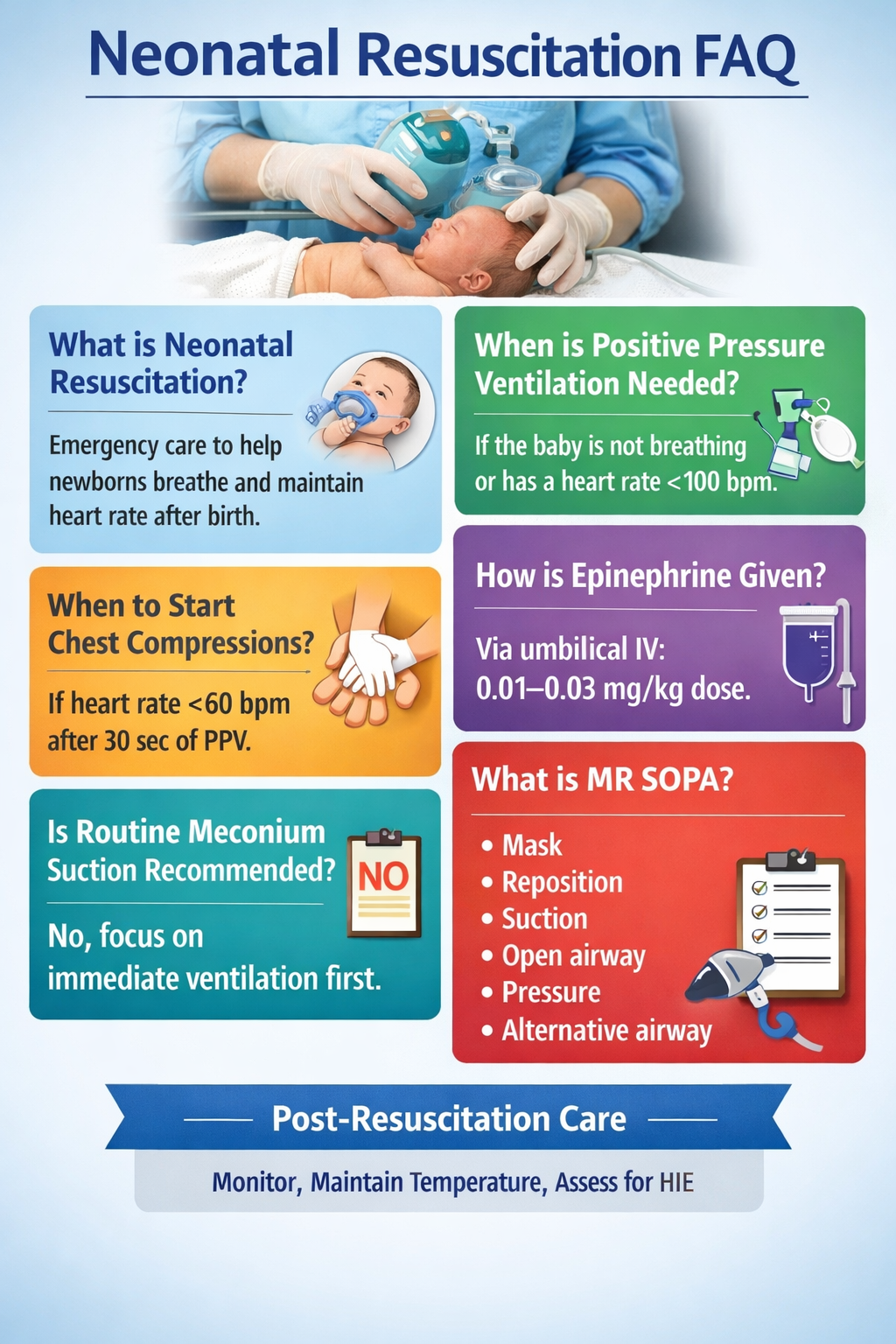
Neonatal resuscitation refers to a series of interventions performed at birth to support airway, breathing, and circulation in newborns who fail to establish effective spontaneous respiration or adequate heart rate after delivery.
About 10% of newborns require some assistance to begin breathing, while 1% require extensive resuscitation measures.
2. Goals of Neonatal Resuscitation
- Establish effective ventilation
- Maintain adequate oxygenation
- Support cardiac output and circulation
- Prevent hypoxia and acidosis
- Maintain normal body temperature
3. Physiological Changes at Birth
At birth the neonate must transition from placental circulation to pulmonary respiration.
Key changes:
| Fetal State | Neonatal State |
| ------------------------------------------------------- | ---------------------------- |
| Placenta provides oxygen | Lungs provide oxygen |
| High pulmonary vascular resistance | Low pulmonary resistance |
| Right-to-left shunts (ductus arteriosus, foramen ovale) | Functional closure of shunts |
| Fluid-filled lungs | Air-filled lungs |
Failure of this transition leads to asphyxia requiring resuscitation.
4. Indications for Neonatal Resuscitation
Resuscitation is required if any of the following are present:
• Apnea or gasping
• Heart rate <100 beats/min
• Poor muscle tone
• Cyanosis or persistent low oxygen saturation
• Poor respiratory effort
5. Risk Factors for Neonatal Depression
Maternal factors
• Diabetes
• Hypertension
• Infection
• Sedative drugs
• Antepartum hemorrhage
Intrapartum factors
• Prematurity
• Meconium-stained amniotic fluid
• Prolonged labor
• Cord prolapse
• Placental abruption
Fetal factors
• Congenital anomalies
• Intrauterine growth restriction
• Multiple gestation
6. Preparation Before Delivery
Team
Minimum one skilled person trained in neonatal resuscitation must be present.
Equipment
Airway:
• Suction device
• Bulb syringe
• Laryngoscope
• Endotracheal tubes
Breathing:
• Self-inflating bag
• T-piece resuscitator
• Oxygen source
Circulation:
• Umbilical venous catheter
• Medications (epinephrine)
Thermal control:
• Radiant warmer
• Warm towels
Monitoring:
• Pulse oximeter
• Stethoscope
• ECG monitor
7. Initial Assessment Immediately After Birth
Three questions are asked:
- Term gestation?
- Good muscle tone?
- Breathing or crying?
If YES to all → routine care
If NO → begin resuscitation
8. Initial Steps of Resuscitation (Golden Minute)
Must be completed within first 60 seconds.
Steps:
- Provide warmth
- Position airway (sniffing position)
- Clear secretions if needed
- Dry the baby
- Stimulate breathing
9. Airway Management
Position
Head in sniffing position to maintain airway patency.
Suctioning
Indications:
• Obstructed airway
• Excess secretions
Order:
- Mouth
- Nose
Suction pressure:
<100 mmHg
Routine suction for meconium is not recommended unless airway obstruction is present.
10. Breathing Support
If after initial steps:
• Apnea
• Gasping
• HR <100 bpm
→ Start Positive Pressure Ventilation (PPV)
Method
Bag and mask ventilation.
Ventilation parameters
| Parameter | Value |
| -------------- | --------------------------- |
| Rate | 40–60 breaths/min |
| Initial oxygen | 21% (room air) in term baby |
| Preterm oxygen | 21–30% |
| Peak pressure | 20–25 cm H₂O |
Goal: chest rise and HR improvement
11. Assessment After 30 Seconds of PPV
Check heart rate.
| Heart Rate | Action |
| ---------- | ------------------------ |
| ≥100 bpm | Stop PPV, observe |
| 60–99 bpm | Continue PPV |
| <60 bpm | Start chest compressions |
12. Chest Compressions
Indication:
Heart rate <60 bpm despite effective ventilation for 30 seconds
Technique
Two-thumb encircling method preferred.
Compression location:
Lower third of sternum.
Ratio
3 compressions : 1 ventilation
Rate
120 events/min
(90 compressions + 30 breaths)
Depth:
1/3 of chest diameter
13. Reassessment
After 60 seconds of compressions + ventilation
Check heart rate.
| HR | Action |
| ------- | ----------------- |
| ≥60 bpm | Stop compressions |
| <60 bpm | Give medications |
14. Medications
1. Epinephrine
Indication
Heart rate <60 bpm after ventilation and chest compressions
Mechanism
Alpha and beta adrenergic agonist → increases heart rate and contractility.
Dose
IV: 0.01–0.03 mg/kg
Concentration:
1:10,000 (0.1 mg/mL)
Route
Preferred: Umbilical vein
Adverse effects
• Hypertension
• Arrhythmia
• Myocardial ischemia
Monitoring
Heart rate and blood pressure.
2. Volume Expansion
Indication:
Suspected hypovolemia or blood loss
Fluid:
Normal saline
Dose:
10 mL/kg IV
15. Oxygen Saturation Targets After Birth
| Time after birth | Target SpO₂ |
| ---------------- | ----------- |
| 1 min | 60–65% |
| 2 min | 65–70% |
| 3 min | 70–75% |
| 4 min | 75–80% |
| 5 min | 80–85% |
| 10 min | 85–95% |
16. Advanced Airway Management
Indications for intubation:
• Ineffective mask ventilation
• Need for prolonged PPV
• Chest compressions required
• Congenital diaphragmatic hernia
Endotracheal tube size:
| Weight | Tube Size |
| ------ | ---------- |
| <1 kg | 2.5 mm |
| 1–2 kg | 3.0 mm |
| 2–3 kg | 3.5 mm |
| >3 kg | 3.5–4.0 mm |
17. Post-Resuscitation Care
Newborns needing resuscitation must be monitored for:
• Hypoglycemia
• Hypothermia
• Hypoxia
• Seizures
• Organ dysfunction
Management includes:
• Oxygen therapy
• IV fluids
• Glucose monitoring
• NICU admission
18. Complications of Birth Asphyxia
• Hypoxic ischemic encephalopathy
• Seizures
• Cerebral palsy
• Multiorgan failure
• Death
19. APGAR Score
Evaluated at 1 minute and 5 minutes
| Parameter | Score 0 | Score 1 | Score 2 |
| ------------------- | ------- | ------------ | --------------- |
| Heart rate | Absent | <100 | ≥100 |
| Respiration | Absent | Slow | Good cry |
| Muscle tone | Flaccid | Some flexion | Active |
| Reflex irritability | None | Grimace | Cry |
| Color | Blue | Body pink | Completely pink |
Score interpretation:
• 7–10 : Normal
• 4–6 : Moderate depression
• 0–3 : Severe depression
20. Neonatal Resuscitation Algorithm (Summary)
- Birth → assess breathing, tone, gestation
- Initial steps (warm, dry, stimulate)
- If HR <100 → PPV
- After 30 sec → check HR
- HR <60 → chest compressions
- If still <60 → epinephrine
If you want, I can also give 20–30 difficult NEET PG / USMLE / Pediatric residency MCQs on Neonatal Resuscitation, which are commonly asked in exams.